Sep
25

Date: 25-September-2026
Time: 1:00 PM ET (New York Time)
Presenter: Dr. Xin Yu
Meeting information:
https://gsu-edu.zoom.us/j/83996077220?pwd=a8NoFiU9nkmBmHVqEttGQbn1ZDKbTn.1
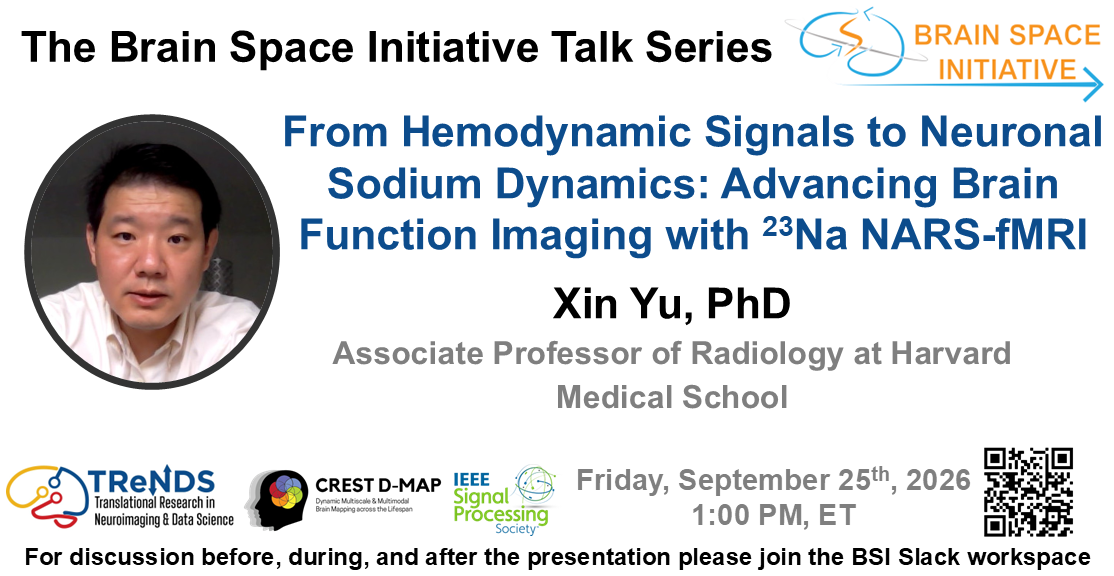
Join us Friday, September 25th, 2026, at 1:00 PM ET for an exciting virtual talk by Dr. Xin Yu entitled: “From Hemodynamic Signals to Neuronal Sodium Dynamics: Advancing Brain Function Imaging with 23Na NARS-fMRI” as part of the activities of the Brain Space Initiative, co-sponsored by the Center for Translational Research in Neuroimaging and Data Science (TReNDS) and the Data Science Initiative, IEEE Signal Processing Society
Abstract
From Hemodynamic Signals to Neuronal Sodium Dynamics: Advancing Brain Function Imaging with 23Na NARS-fMRI
Functional MRI has transformed our ability to map brain activity noninvasively, but conventional BOLD-fMRI primarily measures vascular responses downstream of neuronal activity. Our work has progressively pushed fMRI toward higher spatial and temporal specificity, from laminar and single-vessel imaging to ultrafast measurements of brain-wide dynamics. More recently, we have begun exploring whether MRI can directly access the ionic processes underlying neuronal activity. We developed Neuronal Activity-Related Sodium (NARS)-fMRI, an ultrafast 23Na MRI approach that detects rapid, spatially localized sodium signal changes associated with neuronal activation on the tens-of-milliseconds timescale. NARS responses are reproducible across rodents and are supported by comparisons with electrophysiology, glutamate photometry, and optogenetic circuit stimulation.
Our current work is focused on understanding the physical basis of this signal. Because 23Na is a spin-3/2 nucleus, its relaxation is sensitive to quadrupolar interactions and to changes in sodium mobility and local molecular environments. We hypothesize that activity-dependent sodium redistribution and microenvironmental sampling modulate 23Na quadrupolar relaxation, providing a neuronal-proximal ionic contrast mechanism.
This talk will discuss the development and validation of NARS-fMRI, ongoing efforts to define its biophysical mechanism, and its potential to establish ionic-state imaging as a new dimension of functional MRI.
Biography

Dr. Xin Yu
Xin Yu received his training in MRI and functional neuroimaging at NYU and NIH/NINDS, and later served as a group leader at the Max Planck Institute, where he established the foundations of the Translational Neuroimaging and Neural Control Laboratory (TNNC).
He is currently an Associate Professor of Radiology at Harvard Medical School and Massachusetts General Hospital and a faculty member at the Athinoula A. Martinos Center for Biomedical Imaging where he directs the TNNC Laboratory and the preclinical ultra-high-field MRI facility at the Martinos Center. His research focuses on developing advanced MRI and multimodal imaging technologies to resolve brain function across spatial and temporal scales, spanning laminar and single-vessel fMRI, optical and electrophysiological integration with MRI, and RF sensing. His current work is extending these approaches toward neuronal-proximal ionic imaging using ultrafast 23Na MRI and spin-3/2 quadrupolar relaxation.
Recommended Articles:
• Yu X, Liu X, Yu G, et al. Neuronal-Activity-Related Sodium (NARS) fMRI Reveals Millisecond Neuronal Dynamics Beyond Hemodynamic Readouts. bioRxiv. 2026. (Link to Paper).
• Chen Y, Qian W, Razansky D, Yu X, Qian C. WISDEM: a hybrid wireless integrated sensing detector for simultaneous EEG and MRI. Nat Methods. 2025. (Link to Paper).
• Jiang Y, Pais-Roldán P, Pohmann R, Yu X. High Spatiotemporal Resolution Radial Encoding Single-Vessel fMRI. Adv Sci. 2024. (Link to Paper).
• Yu X, He Y, Wang M, et al. Sensory and optogenetically driven single-vessel fMRI. Nat Methods. 2016. (Link to Paper).
• Yu X, Qian C, Chen DY, Dodd SJ, Koretsky AP. Deciphering laminar-specific neural inputs with line-scanning fMRI. Nat Methods. 2014. (Link to Paper).