Nov
20

Date: 20-November-2026
Time: 1:00 PM ET (New York Time)
Presenter: Dr. Apurva Ratan Murty
Meeting information:
https://gsu-edu.zoom.us/j/81146020597?pwd=0bKqc2WmT5Em8T1N7hMXV8yRHw43Tp.1
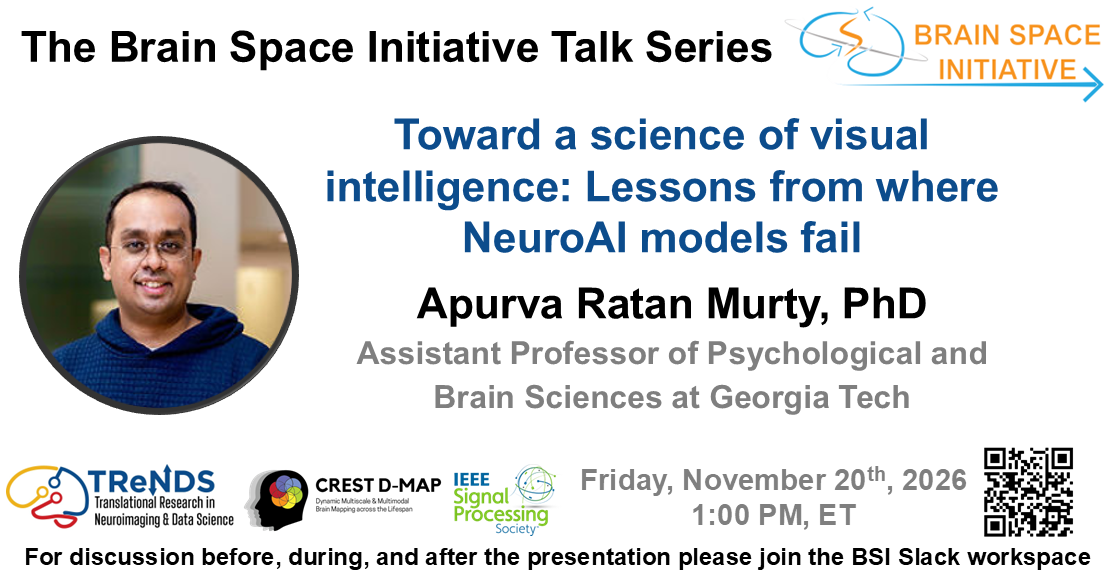
Join us Friday, November 20th, 2026, at 1:00 PM ET for an exciting virtual talk by Dr. Apurva Ratan Murty entitled: “Toward a Science of Visual Intelligence: Lessons From Where NeuroAI Models Fail” as part of the activities of the Brain Space Initiative, co-sponsored by the Center for Translational Research in Neuroimaging and Data Science (TReNDS) and the Data Science Initiative, IEEE Signal Processing Society.
Abstract
Toward a Science of Visual Intelligence: Lessons From Where NeuroAI Models Fail
Over the last decade artificial vision models have fundamentally changed the field of vision neuroscience. These models can recognize objects at human-levels, predict brain activity, and reproduce numerous aspects of human perception. But we are also in a scientific uncanny valley. Although these models capture aspects of behavioral and neural responses, we still struggle to understand what they have learned, why they work as well as they do, and why they sometimes fail in ways that humans do not.
In this talk, I will describe two studies aimed at understanding the bounds of our current models in NeuroAI. First, I will ask how well models of visual cortex generalize beyond the data used to build them. We systematically test model predictions across datasets on data from new images, new participants, and entirely new datasets. I will show that many models generalize surprisingly well but that models have structured and reproducible failures that expose important gaps between artificial and biological vision. In the second study, I will show that current measures of predictivity only concern the global alignment between models and brains, but complete miss how neural responses are organized locally. I will then show the difference between global and local prediction becomes especially salient when we use models to predict and control neural activity in closed-loop experiments. Together, these studies help us understand what current NeuroAI models have learned, where and why they fail, and how we can push beyond neural predictivity toward a deeper understanding of the neural code that supports how we see.
Biography

Dr. Apurva Ratan Murty
Apurva Ratan Murty received the Ph.D. in neuroscience from the Vision Lab at the Indian Institute of Science (IISc) Bangalore in 2016.
He is currently the Smithgall-Watts Early Career Assistant Professor in the School of Psychological and Brain Sciences at Georgia Tech, where he directs the Vision, Cognition, and Computation Lab (murtylab.com). Before joining Georgia Tech, he was a postdoctoral researcher and Research Scientist at MIT’s Center for Brains, Minds and Machines and McGovern Institute for Brain Research, working with Nancy Kanwisher and Jim DiCarlo.
Recommended Articles:
- Ratan Murty, N.A., Bashivan, P., Abate, A. et al. Computational models of category-selective brain regions enable high-throughput tests of selectivity. Nat Commun 12, 5540 (2021). (Link to Paper).
- Ruolin Wang, Mayukh Deb, Alex Abate, ... N. Apurva Ratan Murty. Zero-shot evaluations expose structured generalization limits in predictive models of the brain. bioRxiv 2026.09.15.751562. (Link to Paper).
- Ruolin Wang, Yuxuan Li, Mayukh Deb, ... N Apurva Ratan Murty. 2026. Cortex-Canvas: An Interactive Web Interface for Executing and Evaluating Models of Category-Selective Regions in Human Visual Cortex. In Proceedings of the Extended Abstracts of the 2026 CHI Conference on Human Factors in Computing Systems (CHI EA '26). Association for Computing Machinery, New York, NY, USA, Article 191, 1–7. (Link to Paper).
- McNeal, N. and Apurva Ratan Murty, N. Targeted perturbations reveal brain-like local coding axes in robustified, but not standard, ANN-based brain models, arXiv e-prints, Art. no. arXiv:2509.23333, 2025. (Link to Paper).
Website link: Webinar Link
(https://gsu-edu.zoom.us/j/81146020597?pwd=0bKqc2WmT5Em8T1N7hMXV8yRHw43Tp.1)