Align Before Fusion: Recurrent Multimodal Alignment and Masked Graph Learning for Conversational Emotion
Recognition
Contributed by Tao Meng and co-authors, based on the IEEE Xplore® article, “Masked Graph Learning With Recurrent Alignment for Multimodal Emotion Recognition in Conversation,” published in the IEEE/ACM Transactions on Audio, Speech, and Language Processing, July 2024.
Introduction
Emotion in conversation is conveyed jointly by words, vocal tone, facial expression, speaker identity, and dialogue context. Multimodal Emotion Recognition in Conversation (MERC) combines text, audio, and visual cues to infer the emotion of each utterance, supporting applications such as intelligent dialogue systems, affect-aware human-computer interaction, and public-opinion analysis [1].
Existing MERC methods use graph-based models to capture conversational context and multimodal interactions [2], [3], but many still place greater emphasis on fusion than on the quality and semantic consistency of the representations entering the fusion module. Features extracted independently from text, audio, and vision may contain missing, redundant, or incorrect information, while modality-specific representation spaces create semantic gaps. Alignment-specific approaches have also been explored [4]; however, alignment is often performed only once, limiting the opportunity for each modality to revise its representation using updated information from the others. Direct fusion can therefore propagate noise and weaken cross-modal complementarity.
To address these limitations, the authors develop Masked Graph Learning with Recurrent Alignment (MGLRA), which follows a filter-align-fuse strategy. LSTM encoders first capture conversational context, and graph attention filtering suppresses noisy or redundant information within and across modalities. A memory-based recurrent feature alignment module then iteratively exchanges information among text, audio, and vision, while cross-modal multi-head attention refines their semantic correspondence. Finally, speaker information is incorporated into a randomly masked graph convolutional network that integrates the aligned features and produces emotion predictions. This design completes noise reduction and semantic alignment before final fusion, rather than requiring a single fusion layer to resolve every source of mismatch.
The Proposed Method
In this work, the MGLRA framework shown in Fig. 1 comprises two main stages: recurrent multimodal alignment and masked graph learning. RoBERTa, openSMILE, and a 3D-CNN first extract textual, acoustic, and visual features, respectively, and LSTM encoders incorporate conversational context. Graph attention filtering then suppresses noisy or redundant information before a memory-based recurrent module repeatedly exchanges and refines information across modalities. Cross-modal multi-head attention further captures shared and complementary emotional semantics. The aligned features are subsequently combined with speaker embeddings to construct a conversational graph, in which a masked GCN aggregates multimodal information and an MLP predicts the emotion label.
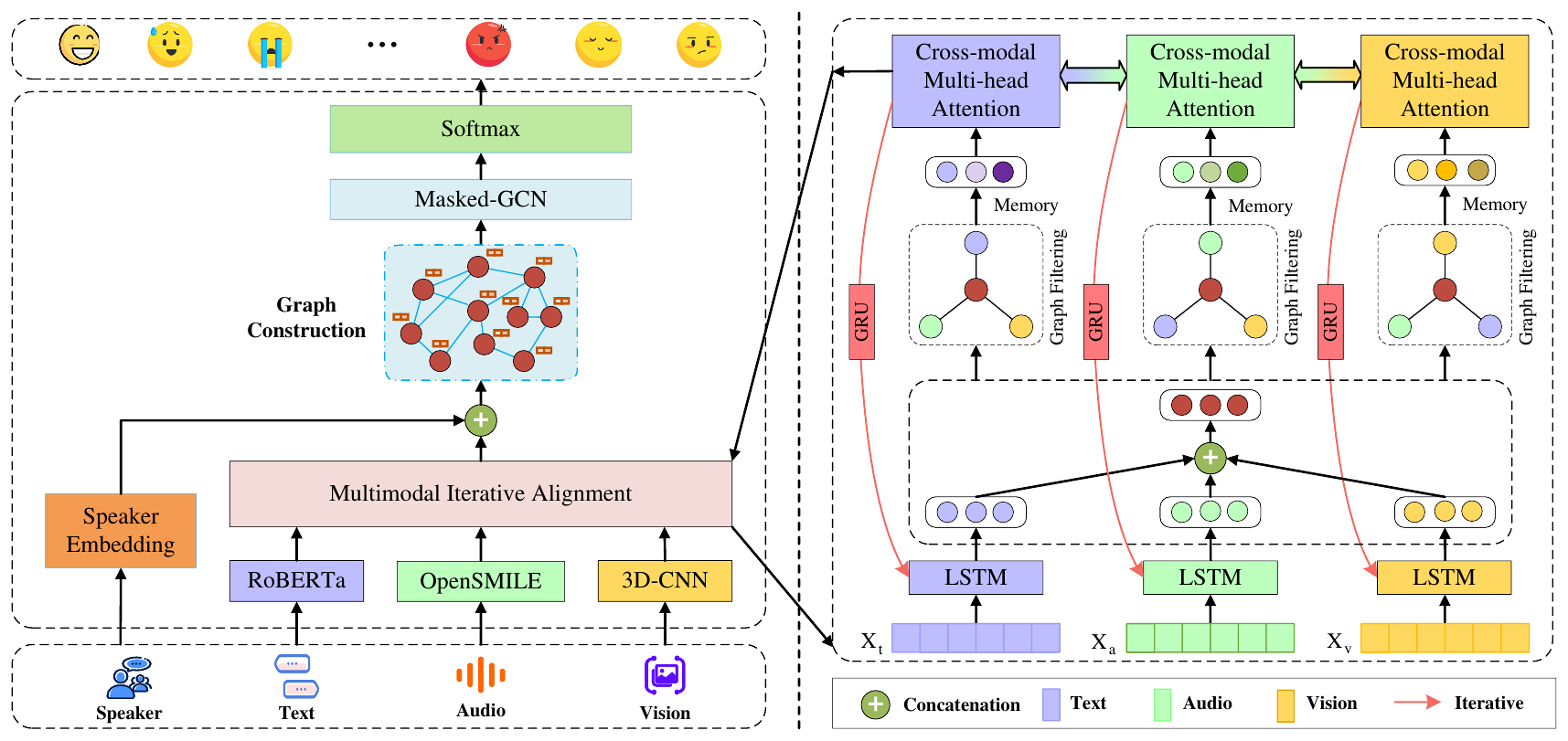
Fig. 1. Overall MGLRA architecture. The left panel presents the end-to-end pipeline from speaker, text, audio, and visual inputs to masked-GCN fusion and emotion classification. The right panel details the recurrent alignment process for the three modalities.
MGLRA differs from fusion-centered approaches in two main respects. Its principal contributions are summarized as follows.
1. We introduce a memory-supported, graph-filtered recurrent alignment strategy that progressively reduces semantic discrepancies among textual, acoustic, and visual representations before multimodal fusion.
2. We develop a speaker-aware masked graph learning strategy that limits redundant graph interactions while aggregating complementary multimodal and contextual information for emotion recognition.
Experimental Results
The original study evaluates MGLRA on the IEMOCAP [5] and MELD [6] benchmarks. Figure 2 qualitatively compares the feature spaces learned on IEMOCAP. Relative to the original features and the representations produced by LSTM and DialogueRNN, MGLRA forms more compact distributions for several emotion categories and improves their visual separation. The visualization therefore provides qualitative evidence that the complete framework learns more discriminative multimodal representations.
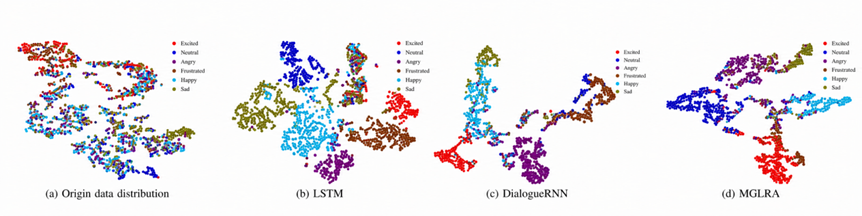
Fig. 2. T-SNE visualization of the feature embedding space on IEMOCAP. From left to right, the panels show the original features and the representations learned by LSTM, DialogueRNN, and MGLRA.
Conclusion
MGLRA organizes conversational emotion recognition into contextual modeling, noise filtering, recurrent alignment, and graph-based fusion. Graph attention filtering suppresses unreliable information; memory-based recurrent alignment allows text, audio, and visual features to refine one another; cross-modal attention captures complementary cues; and a speaker-aware masked GCN integrates the aligned representations for classification. The IEMOCAP visualization indicates that MGLRA forms more compact feature distributions for several emotion categories than the original features, LSTM, and DialogueRNN. This observation highlights the study’s central insight: fusion quality depends not only on the fusion operator, but also on the reliability and semantic consistency of its inputs. MGLRA therefore combines recurrent cross-modal refinement with masked graph learning in a coherent framework for robust conversational emotion representation.
References
[1] L. Yuan, G. Huang, F. Li, X. Yuan, C.-M. Pun, and G. Zhong, “Rba-gcn: Relational bilevel aggregation graph convolutional network for emotion recognition,” IEEE/ACM Transactions on Audio, Speech, and Language Processing, vol. 31, pp. 2325–2337, 2023. DOI: 10.1109/TASLP.2023.3284509
[2] D. Ghosal, N. Majumder, S. Poria, N. Chhaya, and A. Gelbukh, “DialogueGCN: A Graph Convolutional Neural Network for Emotion Recognition in Conversation,” in Proc. EMNLP-IJCNLP, pp. 154–164, 2019.
[3] J. Hu, Y. Liu, J. Zhao, and Q. Jin, “MMGCN: Multimodal Fusion via Deep Graph Convolution Network for Emotion Recognition in Conversation,” in Proc. ACL-IJCNLP, pp. 5666–5675, 2021.
[4] H. Xu, H. Zhang, K. Han, Y. Wang, Y. Peng, and X. Li, “Learning Alignment for Multimodal Emotion Recognition from Speech,” in Proc. Interspeech, pp. 3569–3573, 2019.
[5] C. Busso et al., “IEMOCAP: Interactive Emotional Dyadic Motion Capture Database,” Lang. Resour. Eval., vol. 42, pp. 335–359, 2008.
[6] S. Poria et al., “MELD: A Multimodal Multi-Party Dataset for Emotion Recognition in Conversations,” in Proc. ACL, 2019, pp. 527–536.
Tags
Graph representation learning, multimodal emotion recognition, multimodal fusion