CNN Architecture Design for Extremely Weak Signal Detection

Research Spotlight
Contributed by Dr. Hanzhou Wu and co-authors, based on IEEEXplore® article “Structural design of convolutional neural networks for steganalysis”, published in the IEEE Signal Processing Letters, vol. 23, no. 5, pp. 708-712, May 2016.
The Challenge of Detecting Extremely Weak Signals
Many information forensics and security tasks rely on detecting signals that are difficult to observe. In image steganography, for example, secret information is embedded through slight modifications to pixels. These modifications are imperceptible to the human visual system and easily masked by the much stronger image content. Consequently, the traces left by hidden data form an extremely weak signal, making the detection of concealed information a fundamental challenge in steganalysis, the countermeasure to steganography.
The difficulty stems from an inherently low “noise-to-signal” ratio. The steganographic signal only occupies a tiny fraction of the image, while natural image content such as textures, edges, and object structures, produces much stronger responses. As a result, the subtle traces associated with hidden information are often buried beneath dominant visual content.
This challenge is fundamentally different from conventional computer vision tasks. While image classification and object recognition aim to extract high-level semantic information, steganalysis seeks to identify subtle statistical anomalies that carry little semantic meaning. Features that are highly informative for visual understanding may therefore be irrelevant, or even detrimental, to the detection of hidden information. As a result, convolution neural network (CNN) architectures optimized for semantic understanding in computer vision may not be well suited to the detection of extremely weak signals, motivating the need for task-specific architectural design.
CNN Architecture Design
Rather than interpreting image content, steganalysis seeks to detect subtle traces introduced by the embedding of hidden information. These traces often reside in fine-grained statistical variations that can be easily discarded during feature extraction. Architectural components that improve robustness to image content may therefore inadvertently suppress the very signals that steganalysis aims to detect.
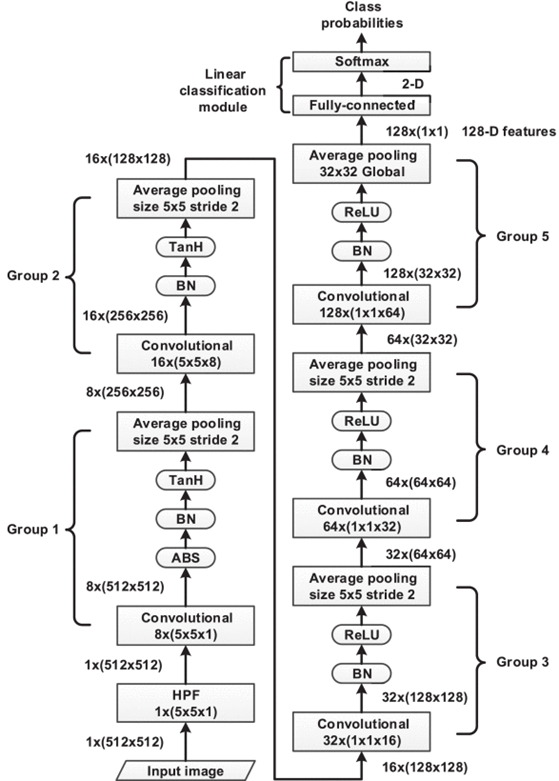
To deal with this challenge, we report a CNN architecture that takes into account knowledge of steganalysis. In the detailed architecture, a high-pass filtering (HPF) layer with a fixed kernel, whose parameters are not optimized during training, is placed at the very beginning to transform original images to noise residuals. As shown in Figure 1, the entire CNN can be divided into a convolutional module which transforms the images to feature vectors (128-D), and a linear classification module, composed of a fully connected (FC) layer and a softmax layer, which transforms feature vectors to output probabilities for each class. The convolutional module comprises five groups of layers (displayed as “Group 1” to “Group 5” in Figure 1), each starts with a convolutional layer which generates feature maps, and ends with an average pooling layer which performs local averaging as well as subsampling on the feature maps (except Group 5).
To enhance the power of statistical modeling, our CNN is equipped with the hyperbolic tangent (TanH) nonlinear activations for Group 1 and Group 2, and the rectified linear
unit (ReLU) activations for Group 3, Group 4, and Group5. Inside Group1, an absolute activation (ABS) layer is inserted to force the statistical modeling to take into account the (sign) symmetry existed in noise residuals. To prevent the CNN training from falling into poor local minima, and learn optimal scales and biases for feature maps, batch normalization (BN) is performed immediately before each nonlinear activation layer.
Finally, through global averaging, the pooling layer in Group 5 merges each spatial map to a single element (128 maps of size 32×32 to 128-D features). In this way, the entire CNN is constraint to perform the same operations to every pixel in the original images (or the noise residuals), thereby preventing the statistical modeling from grasping the location information of embedded pixels from the training data.
Implications for Information Forensics and Security
Although the proposed CNN is neither particularly large nor deep and relies on only a single type of noise residual, it achieves performance comparable to that of previous state-of-the-art models. These results demonstrate that effective steganalysis does not necessarily require increasingly complex architectures. Instead, success depends critically on aligning network design with the unique characteristics of the target signal.
More broadly, this work highlights the importance of task-specific architectural design in deep learning. For extremely weak signal detection, architectures developed for conventional computer vision tasks may not provide the most effective solution. By explicitly suppressing image content and enhancing weak signal traces, CNNs can be tailored to better address the challenges of hidden information detection.
The implications extend beyond steganalysis. Many problems in information forensics and security involve identifying subtle patterns that are easily overwhelmed by dominant data content, including digital forensics, multimedia authentication, anomaly detection, and covert communication analysis. The design principles explored in this work suggest a general framework for adapting deep learning models to tasks where weak signals, rather than semantic content, carry the most critical information.
As deep learning continues to advance, understanding how architectural choices influence the preservation and amplification of weak signals may become increasingly important for the next generation of information forensics and security technologies.