Aug
28
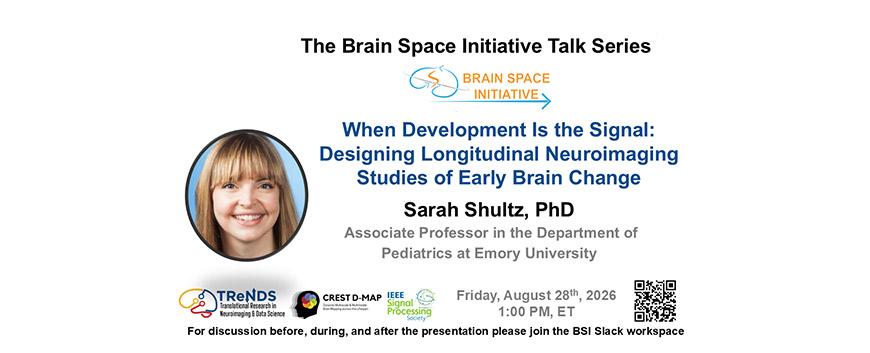
Date: 28-August-2026
Time: 1:00 PM ET (New York Time)
Presenter: Dr. Sarah Shultz
Meeting information:
https://gsu-edu.zoom.us/j/82872749877?pwd=RsCCPm8eezPhZ9nlBzlZLYdhabmcAa.1
Join us Friday, August 28th, 2026, at 1:00 PM ET for an exciting virtual talk by Dr. Sarah Shultz entitled: “When Development Is the Signal: Designing Longitudinal Neuroimaging Studies of Early Brain Change” as part of the activities of the Brain Space Initiative, co-sponsored by the Center for Translational Research in Neuroimaging and Data Science (TReNDS) and the Data Science Initiative, IEEE Signal Processing Society.
Abstract
When Development Is the Signal: Designing Longitudinal Neuroimaging Studies of Early Brain Change
Neurodevelopmental conditions such as autism are increasingly understood not as fixed alterations in brain or behavior, but as developmental phenomena that emerge through dynamic processes unfolding over time. Understanding the neurobiology of these conditions therefore requires approaches capable of characterizing developmental change—when it occurs, how it unfolds, and how trajectories vary across individuals. This conceptual shift has driven increasing interest in longitudinal neuroimaging beginning very early in life.
Yet studying brain development longitudinally during infancy presents substantial methodological challenges. The unique properties of the infant brain pose challenges for applying neuroimaging tools largely developed for mature brains, while rapid developmental change further complicates the use of consistent acquisition and processing approaches across infancy. In this talk, I will use our ongoing longitudinal infant studies as a case example to consider how these challenges shape the design and analysis of longitudinal developmental neuroimaging studies. I will highlight recent methodological progress in longitudinal registration of the rapidly developing infant brain as one example of efforts to address these challenges. Finally, I will present recent work demonstrating how temporally resolved measures of longitudinal change can reveal transitions in early functional brain organization that would otherwise be difficult to detect. Together, these examples illustrate both the methodological demands and the scientific opportunities that arise when development itself is the signal of interest.
Biography

Dr. Sarah Shultz
Sarah Shultz received the Ph.D. in Psychology from Yale University where she trained in developmental cognitive neuroscience.
She is currently an Associate Professor in the Department of Pediatrics at Emory University School of Medicine and Director of the Pediatric Neuroimaging Research Core at Marcus Autism Center. Her research integrates longitudinal neuroimaging with behavioral approaches to understand early brain and behavioral development, with a particular focus on social development during infancy and developmental pathways associated with autism.
Recommended Articles:
- Korom M, Camacho MC, Filippi CA, Licandro R, Moore LA, Dufford A, Zöllei L, Graham AM, Spann M, Howell B; FIT’NG; Shultz S, Scheinost D. Dear reviewers: Responses to common reviewer critiques about infant neuroimaging studies. Dev Cogn Neurosci. 2022. (Link to Paper).
- Duan K, Li L, Calhoun VD, Shultz S. Groupwise registration of infant brain diffusion tensor images using intermediate subgroup templates. PLoS One. 2025. (Link to Paper).
- Risk BB, Li L, Jones W, Shultz S. Dynamics of infant white matter maturation from birth to 6 months. Commun Biol. 2026. (Link to Paper).
Website link: Webinar Link
(https://gsu-edu.zoom.us/j/82872749877?pwd=RsCCPm8eezPhZ9nlBzlZLYdhabmcAa.1)