
Dr. Fan Liu

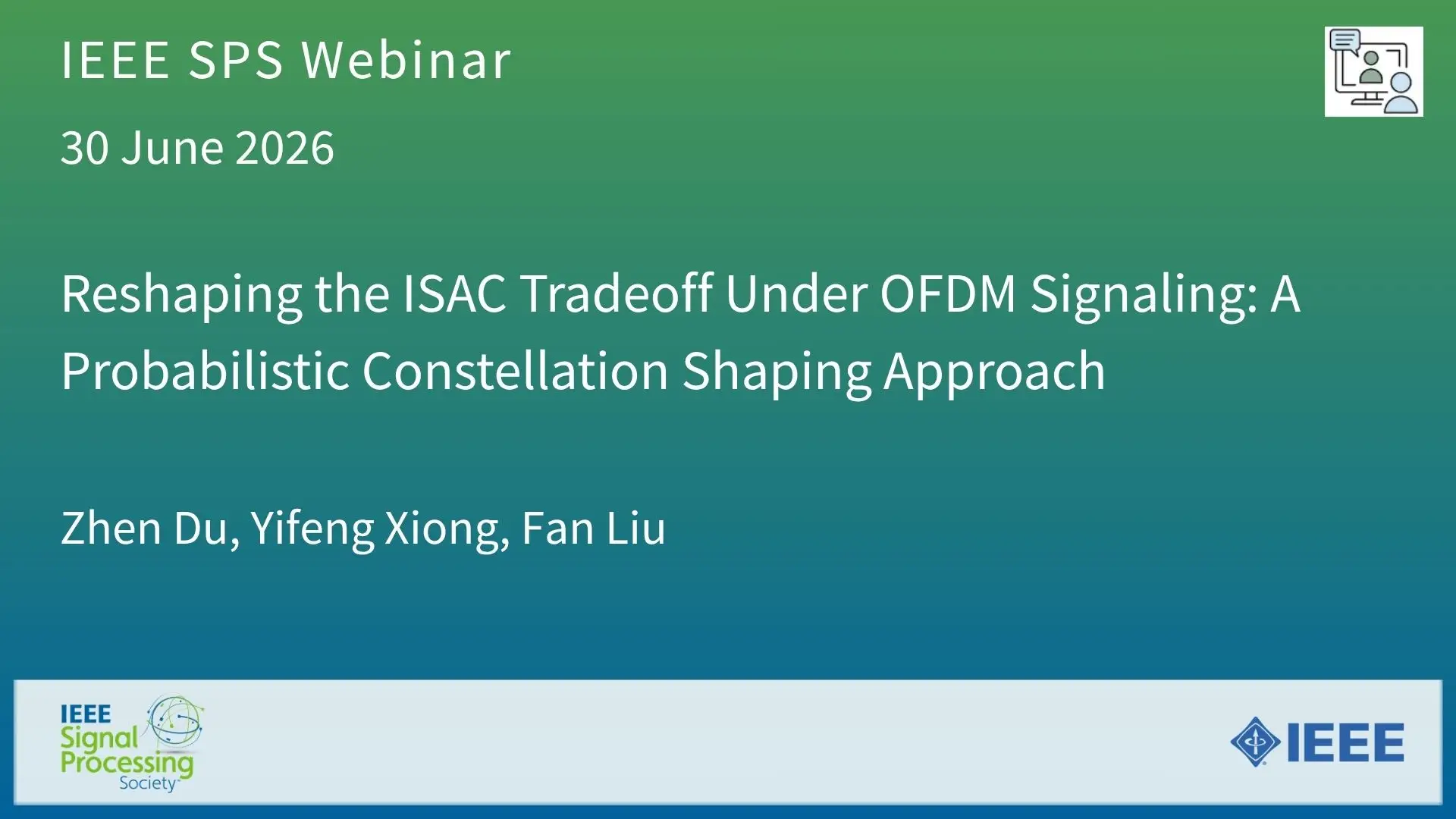
Webinar: Reshaping the ISAC Tradeoff Under OFDM Signaling: A Probabilistic Constellation Shaping Approach (video)
SHARE:
Category
Proficiency
Language
Media Type
Pricing

SPS Members $0.00
IEEE Members $11.00
Non-members $15.00

Date

"Reshaping the ISAC Tradeoff Under OFDM Signaling: A Probabilistic Constellation Shaping Approach" presented by Dr. Zhen Du, Dr. Yifeng Xiong and Dr. Fan Liu.  Based on the IEEE Xplore® article under the same title. Published IEEE Transactions on Signal Processing, September 2024. Visit article article here.

Integrated Sensing and Communications (ISAC) is widely recognized as a key technological driver for next-generation wireless systems. Exploiting orthogonal frequency division multiplexing (OFDM) communication waveforms for sensing offers a low-cost and hardware-efficient approach toward practical ISAC deployment. However, the impact of communication randomness on sensing performance remains insufficiently quantified, and the sensing-communication trade-off is often difficult to flexibly adjust according to diverse service requirements.

This webinar will present a theoretical framework that characterizes the randomness of the radar ambiguity function under communication signaling. By analyzing the matched filtering behavior, the presenters will reveal a fundamental result: sensing performance is determined by the fourth-order moment of constellation amplitudes. Based on this insight, they outline an optimal probabilistic constellation shaping strategy to achieve a controllable sensing-communication trade-off. The proposed approach depends only on the probability distribution of the transmitted constellation, without requiring channel state information or specific data realizations, leading to low complexity and practical implementability. Extensions of the framework to mismatched filtering conditions will also be discussed.
Duration
00:56:13
Subtitles
✖

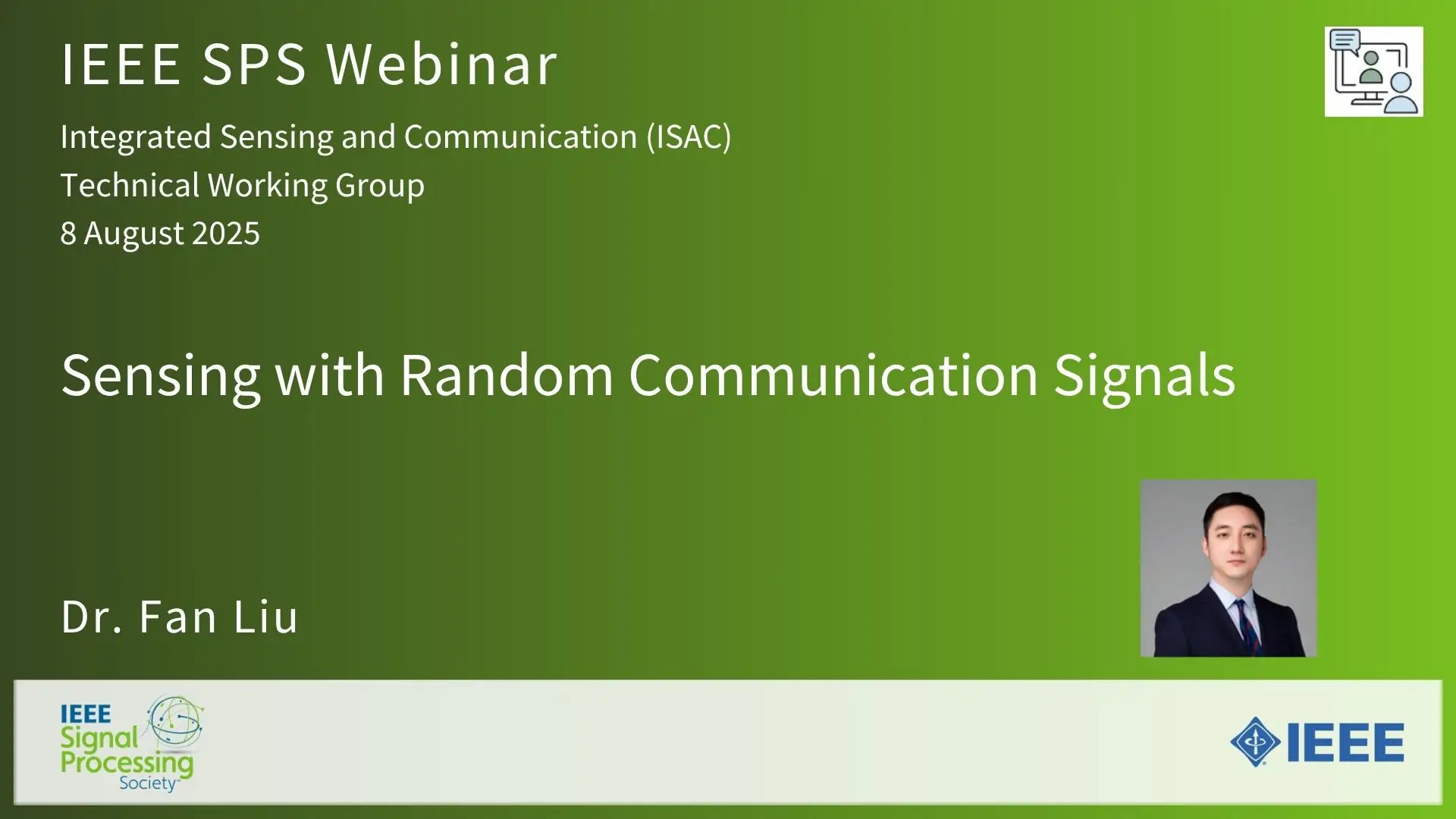
Sensing with Random Communication Signals (video)

SHARE:
Category
Proficiency
Language
Media Type
Pricing

SPS Members $0.00
IEEE Members $11.00
Non-members $15.00

Authors
Date
The Integrated Sensing and Communications (ISAC) paradigm is anticipated to be a cornerstone of the upcoming 6G networks. In order to optimize the use of wireless resources, 6G ISAC systems need to harness the communication data payload signals, which are inherently random, for both sensing and communication (S&C) purposes. This talk will provide a comprehensive technical overview of the signal processing methodologies for ISAC transmission with random communication signals. The presenter begins by introducing the deterministic-random tradeoff (DRT) between S&C from an information-theoretic perspective, emphasizing the need for specialized signal processing techniques tailored to random ISAC signals. Building on this foundation, he will review the core signal models and processing pipelines for communication-centric ISAC systems, and analyze the average squared auto-correlation function (ACF) of random ISAC signals, which serves as a fundamental performance metric for multi-target ranging tasks. Drawing insights from these theoretical results, he outlines the design principles for the three key components of communication-centric ISAC systems: modulation schemes, constellation design, and pulse shaping filters. The goal is to either enhance sensing performance without compromising communication efficiency or to establish a scalable tradeoff between the two. Finally, he will conclude by highlighting several open challenges and future research directions in the field of sensing with communication signals.
Duration
1:17:46
Subtitles
✖

IEEE SPS Education Center FAQs

The IEEE SPS Education Center is your hub for educational resources in signal processing. It offers a variety of materials tailored for students and professionals alike. You can explore content based on your specific interests and skill levels.

Select the program and click on the external link to the IEEE SPS Resource Center.

Educational credits in the form of professional development hours (PDHs) or continuing education units (CEUs) are available on select educational programs.
