From Labs to Learners: Preparing the Next Generation Signal Processing Workforce through Industry-Academic Coalitions
Panel organized by IEEE SPS Education Board as part of the Industry Program during ICASSP 2026 in Barcelona, Spain
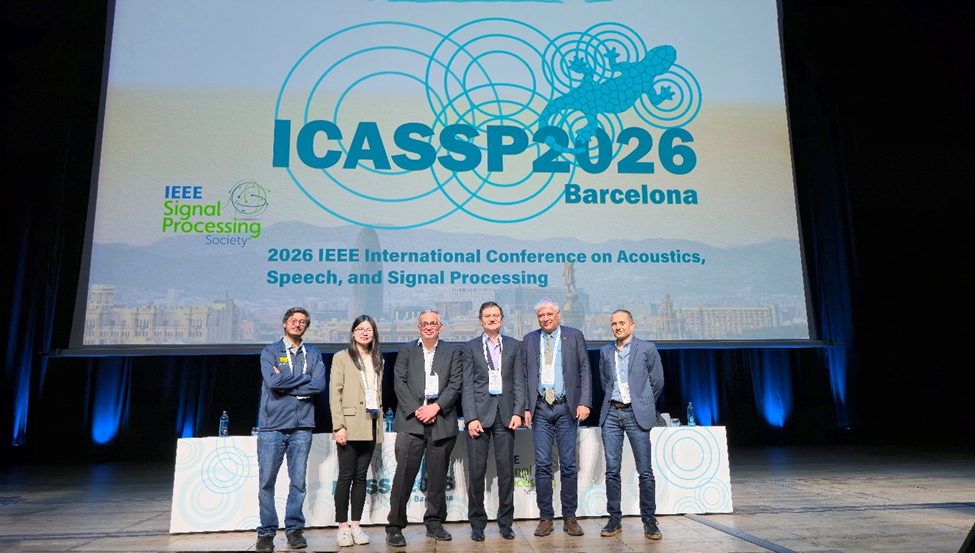
Organizers and moderators of the panel were
- Arvind Rao, Professor at the University of Michigan, Ann Arbor
- Yang Lei, Principal Research Engineer and Tech Lead at HP Inc.
Members of the panel were
- Ioannis Katsavounidis, Research Scientist at Meta
- Ivan Tashev, Partner Software Architect at Microsoft Research
- Gabriele Bunkheila, Product Management, DSP and Audio at MathWorks
- Marios S. Pattichis, Professor at University of New Mexico.
Short summary
The panel emphasized that in the AI era, deep domain expertise in signal processing remains the key differentiator, as AI enhances but does not replace experts; instead, those who effectively leverage AI will outperform others. It highlights the importance of maintaining strong fundamentals, fostering critical thinking, and addressing the risks of overreliance on AI-generated code, which may lack sound architecture. To better prepare the workforce, the discussion calls for closer industry–academic collaboration through synthetic data, shared training content, and permanent educational resources such as data challenges. It also underscores the growing need for continuous learning, as knowledge evolves rapidly, and stresses that soft skills—alongside technical expertise—are essential for career success.
Discussion
Discussions focused on the transformative impact of generative AI, the importance of foundational signal processing literacy, and the role of interdisciplinary fluency in preparing students for modern industry demands. Panelists emphasized the need for students to master core concepts such as Fourier transforms, linear algebra, probability, and the sampling theorem, while also cultivating the critical thinking skills required to use AI tools effectively. Ivan Tashev underscored the indispensable role of domain experts in defining architectures, curating data, and establishing evaluation metrics for AI systems. Ioannis Katsavounidis highlighted Meta’s contributions to video compression and quality, emphasizing domain-specific expertise as a key workforce differentiator. Gabriele Bunkheila (MathWorks) advocated for modular courseware and challenge-based projects to bridge academia and industry, while Marios Pattichis discussed K–12 outreach initiatives aimed at introducing programming and signal processing concepts to younger students.
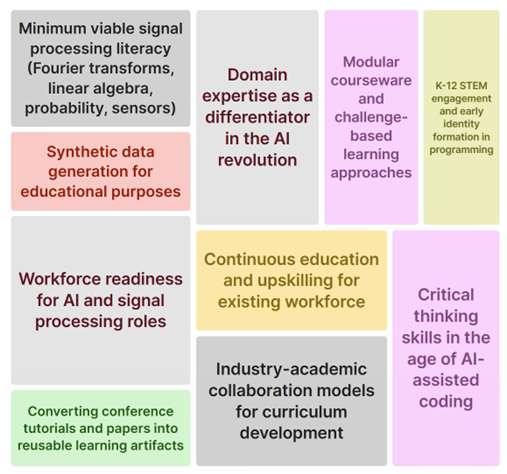
The panel also explored collaborative opportunities, including leveraging the SPS CEP program and engineering platforms to scale educational efforts. Suggestions included creating standardized training modules, synthetic datasets, and permanent challenges to address real-world problems. Panelists proposed crash courses and expert-to-non-expert talks to improve signal processing literacy among broader audiences, ensuring greater accessibility and understanding.
Flexibility in academic curricula was deemed essential to keep pace with rapid technological change. The IEEE Signal Processing Society was identified as a key facilitator, with its webinars, tutorials, and competitions serving as valuable resources. By fostering industry–academic partnerships and leveraging platforms such as Hugging Face for challenges, the panel envisioned a future where signal processing education is more equitable, accessible, and aligned with industry needs—ultimately empowering the next generation of professionals.
More information about the panel and panelists’ bios can be found here: Industry Program - 2026 IEEE International Conference on Acoustics, Speech, and Signal Processing. The full panel presentation is also available on the SPS Resource Center
Note: This material was prepared based on AI-generated summary of the discussion during the panel. Click here to view the Snapsight summary for this panel session and more from ICASSP 2026.