
Contributed by Yanqing Xu and co-authors, based on the IEEEXplore® article, “Distributed Signal Processing for Extremely Large-Scale Antenna Array Systems: State-of-the-Art and Future Directions”, published in the IEEE Journal of Selected Topics in Signal Processing, Feb. 2025.
Introduction
To meet the performance targets envisioned for 6G and beyond, antenna arrays are scaling toward extremely large-scale antenna arrays (ELAAs) with hundreds or even thousands of elements, aiming to unlock finer beam focusing, higher spectral/energy efficiency, and new sensing/positioning capabilities. In practice, ELAA systems often appear in three forms: single base station (BS) ELAAs that scale up one base station; coordinated distributed antenna systems (e.g., coordinated multi-cell transmission and distributed, a.k.a. cell-free massive multiple-input multiple-output (MIMO)); and ELAAs integrated with emerging technologies, such as network-controlled repeaters, backscatter communications, reconfigurable intelligent surface (RIS), and integrated sensing and communications (ISAC) [1], see Fig. 1.
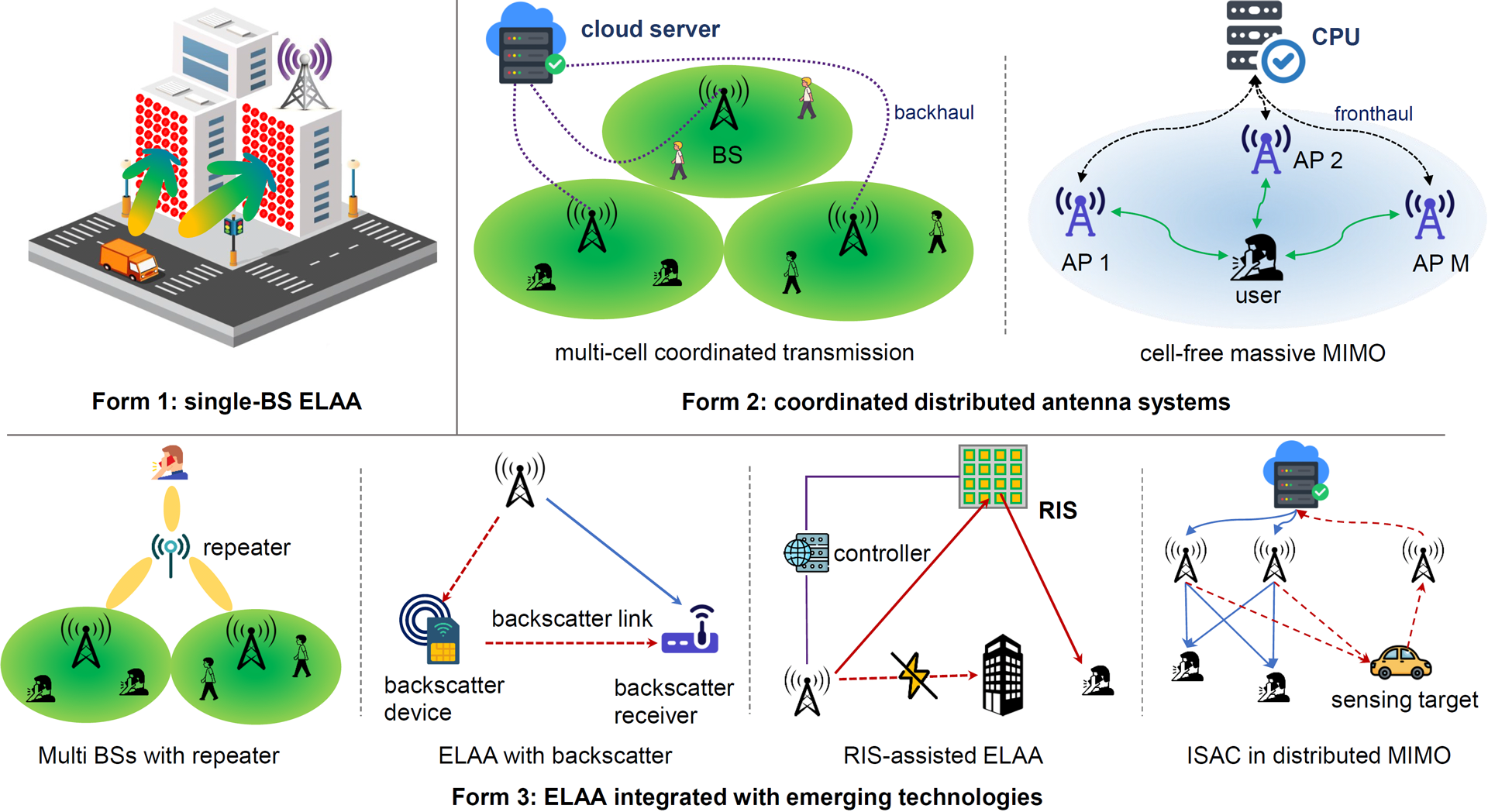
However, moving to the ELAA regime is faced with serval major signal-processing bottlenecks. Specifically, many high-performance transceiver algorithms become computationally prohibitive as problem dimensions grow, while centralized baseband processing requires collecting raw signals and CSI from massive arrays, resulting in excessive interconnection cost. Meanwhile, the extremely large antenna count also makes high-precision synchronization and calibration increasingly challenging [2]. These challenges motivate distributed signal processing, where multiple processing nodes perform local computations and exchange only compact intermediate information, offering a scalable path to make ELAA gains practical. In what follows, we introduce the state-of-the-art distributed signal processing techniques for the three representative forms of ELAA systems.
Distributed Signal Processing for Signal-BS ELAA System under DBP Architectures
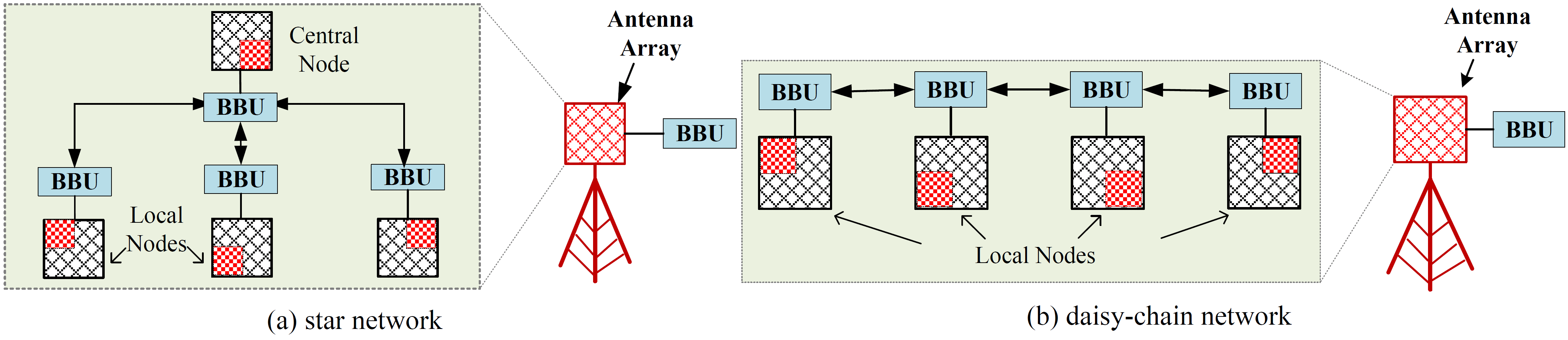
A practical way to scale a single base station to ELAA dimensions is decentralized baseband processing (DBP), where the array is partitioned into multiple antenna clusters with local BBUs connected via fronthaul (e.g., star or daisy-chain topologies), see Fig. 2. DBP enables distributed signal processing by letting each node compute locally and exchange only low-dimensional intermediate information, which helps relieve two key ELAA bottlenecks: excessive interconnection cost and high computational complexity.
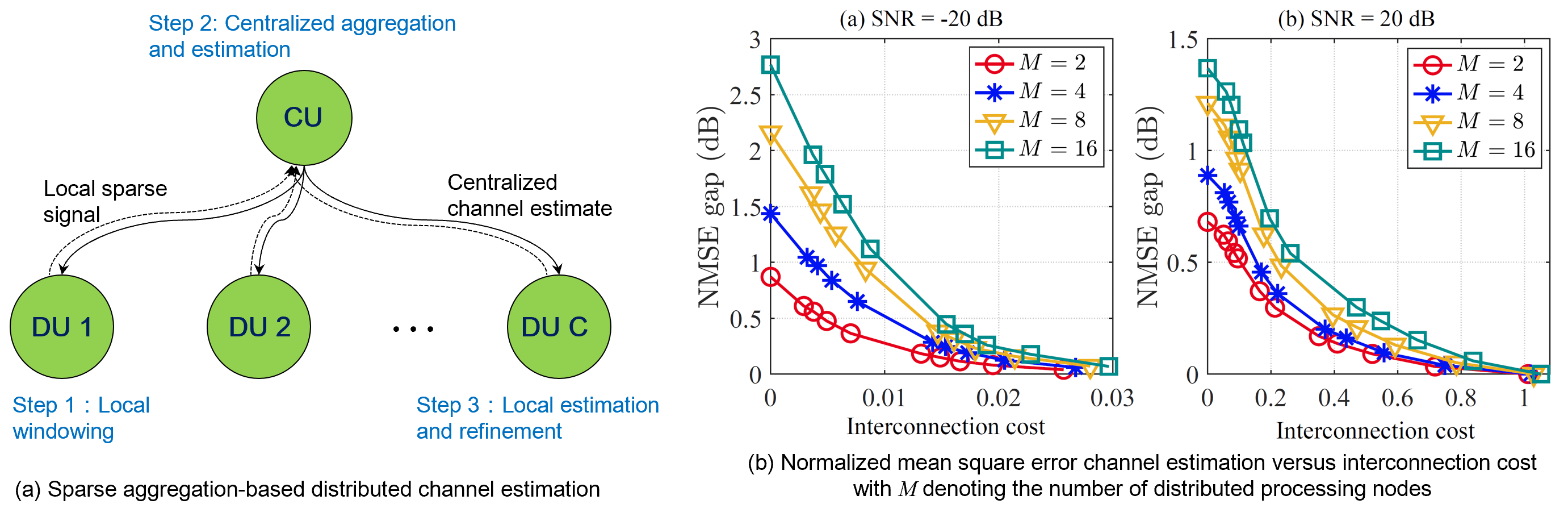
Based on DBP architectures, a sparse aggregation-based distributed channel estimation algorithm was proposed in [3], see Fig. 3(a). In particular, each processing node first performs local preprocessing of its pilot observations to extract a compact set of informative channel components (leveraging the channel’s underlying sparsity/structure), and then uploads only these low-dimensional summaries to an aggregation node. The aggregation node fuses the received summaries to refine the global channel estimate and broadcasts the key feedback needed by the local nodes. Importantly, this procedure requires only one roundtrip information exchange, which leads to low fronthaul signaling overhead and low latency, while still achieving an effective accuracy–overhead tradeoff for ELAA-scale systems, see Fig. 3(b).
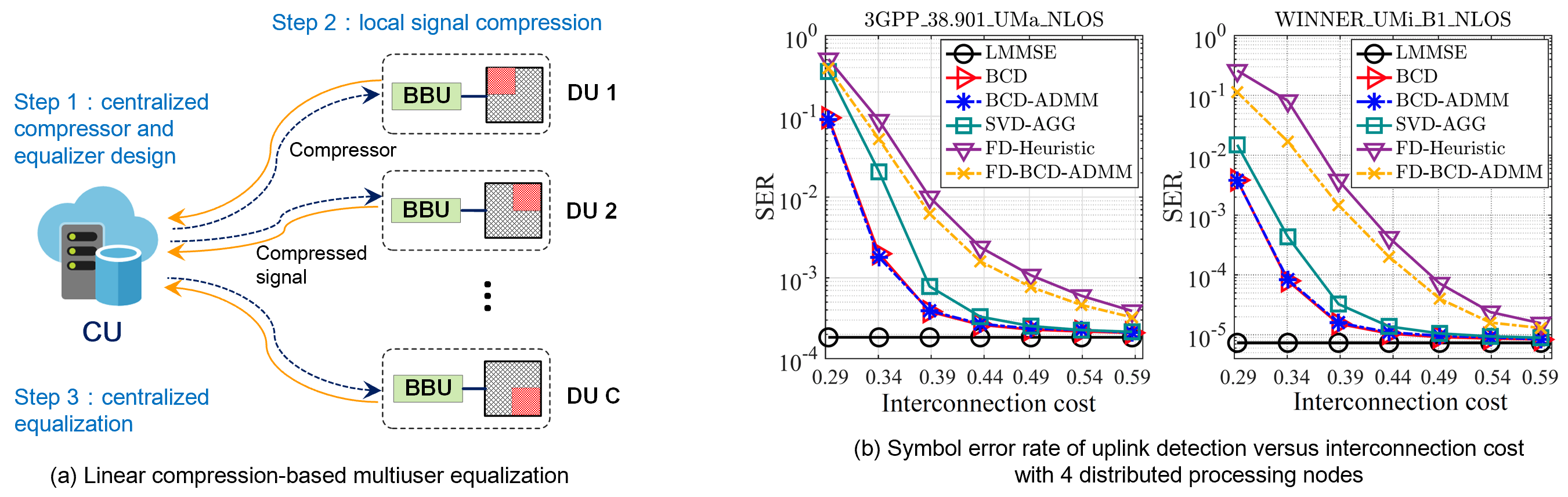
For uplink multiuser equalization under DBP, many existing decentralized designs rely on iterative information exchange among distributed nodes, which can incur substantial fronthaul overhead when the interconnection bandwidth is limited. This motivates linear compression-based MUE (LC-MUE), which removes the redundancy in the local received signals (often due to having many more antennas than users per node) and forwards only dimension-reduced observations for joint processing [4], see Fig. 4(a). Importantly, this is achieved with only one roundtrip information exchange, leading to low fronthaul signaling overhead and low latency, while still approaching centralized equalization performance in practical multi-carrier settings, see Fig. 4(b). Similar ideas can also be applied to downlink beamforming [5].
Distributed Signal Processing for Coordinated Distributed Antenna Systems
Many distributed signal processing algorithms developed for single-BS ELAA systems can be extended to coordinated distributed antenna systems. However, the multi-BS setting introduces additional bottlenecks: (i) a powerful central processor may be unavailable, and (ii) geographically distributed antennas lead to highly heterogeneous link qualities, making “all antennas serve all users” inefficient. To cope with these challenges, representative distributed beamforming/precoding approaches include: (i) local metrics such as signal-to-leakage-and-noise ratio (SLNR) to control leakage using only local CSI; (ii) user-cooperation-based coordination, which acquires necessary cross-term information via uplink signaling and CSI combining rather than backhaul CSI exchange (but may require iterative processing); (iii) interference-summary exchange, which shares limited quantities (e.g., inter-cell interference powers) instead of full CSI; and (iv) virtual power-control reformulation, where BSs exchange only interference channels and power variables—an exchange that does not scale with the antenna number and is thus appealing for ELAA deployments [6].
Distributed SP for ELAA Systems Integrated with Emerging Technologies
Finally, beyond simply scaling antenna numbers, another trend is to integrate emerging technologies into ELAA systems to further improve coverage, spectral/energy efficiency, and enable new functionalities such as sensing. Representative examples include network-controlled repeaters, backscatter communications, RISs, and ISAC [7]-[10]. These technologies can create or reshape propagation paths and add sensing capability, but they also introduce new distributed signal processing challenges—most notably efficient channel state information acquisition, distributed control/coordination with limited signaling, and scalable joint optimization across active arrays and passive/low-power components under practical latency and overhead constraints.
Conclusion
ELAA systems promise major 6G performance improvements, but realizing them in practice requires overcoming the bottlenecks of computational complexity and interconnection cost. Distributed signal processing provides a scalable pathway by shifting key baseband tasks, such as channel estimation, multiuser equalization, and beamforming, from centralized processing to cooperative designs with local computing and limited information exchange. Across single-BS decentralized baseband processing architectures, coordinated distributed antenna systems, and ELAA deployments integrated with emerging technologies, the common theme is to carefully balance performance with fronthaul/backhaul overhead, latency, and implementation constraints, making ELAA systems not only powerful in theory, but also practical in real networks. Looking ahead, promising directions include near-field-aware modeling and algorithm design, robustness to CSI/hardware impairments, and learning-assisted methods that further reduce coordination overhead.
References
- Y. Xu, E. G. Larsson, E. A. Jorswieck, X. Li, S. Jin, and T.-H. Chang,“Distributed Signal Processing for Extremely Large-Scale Antenna Array Systems: State-of-the-Art and Future Directions,” in IEEE J. Sel. Top. Signal Process., vol. 19, no. 2, pp. 304-330, Mar. 2025, doi:https://dx.doi.org/10.1109/JSTSP.2025.3541386.
- E. G. Larsson, “Massive Synchrony in Distributed Antenna Systems,” in IEEE Trans. Signal Process., vol. 72, pp. 855-866, 2024, doi: https://dx.doi.org/10.1109/TSP.2024.3358618.
- Y. Xu, B. Wang, E. Song, Q. Shi and T.-H. Chang, “Low-Complexity Channel Estimation for Massive MIMO Systems With Decentralized Baseband Processing,” in IEEE Trans. Signal Process., vol. 71, pp. 2728-2743, Jun. 2023, doi: https://dx.doi.org/10.1109/TSP.2023.3293329.
- Y. Xu, L. Zhu, R. Shi, and T.-H. Chang, “Joint Compression and Multiuser Equalization for Multi-carrier Massive MIMO Systems With Decentralized Baseband Processing,” in IEEE Trans. Signal Process., vol. 72, pp. 5708-5724, Dec. 2024, doi: https://dx.doi.org/10.1109/TSP.2024.3497312.
- R. Shi, Y. Xu, L. Zhu, and T.-H. Chang, “Linear Compression-based Precoding for Massive MIMO Systems With Decentralized Baseband Processing,” in proc. IEEE ICC Workshop, Jun. 2024, doi: https://dx.doi.org/ 10.1109/ICCWorkshops59551.2024.10615459.
- T. Cai, S. Ge, Y. Xu, and T.-H. Chang, “Approaching Centralized Multi-cell Coordinated Beamforming With Limited Backhaul Signaling," in Proc. IEEE ICC , May 2023, doi: https://dx.doi.org/10.1109/ICC45041.2023.10278830.
- S. Willhammar, H. Iimori, J. Vieira, L. Sundström, F. Tufvesson and E. G. Larsson, “Achieving Distributed MIMO Performance with Repeater-Assisted Cellular Massive MIMO,” in IEEE Commun. Mag., vol. 63, no. 3, pp. 114-119, Mar. 2025, https://dx.doi.org/10.1109/MCOM.001.2400332.
- D. Mishra and E. G. Larsson, “Optimal channel estimation for reciprocity-based backscattering with a full-duplex MIMO reader,” IEEE Trans. Signal Process., vol. 67, no. 6, pp. 1662–1677, Mar. 2019, https://dx.doi.org/10.1109/TSP.2019.2893859.
- I. Santamaria, M. Soleymani, E. Jorswieck and J. Gutiérrez, "Interference Minimization in Beyond-Diagonal RIS-Assisted MIMO Interference Channels," in IEEE Open J. Veh. Technol., vol. 6, pp. 1005-1017, 2025, https://dx.doi.org/10.1109/OJVT.2025.3555425.
- H. Que, J. Yang, C.-K. Wen, S. Xia, X. Li, and S. Jin, “Joint beam management and SLAM for mmWave communication systems,” IEEE Trans. Commun., vol. 71, no. 10, pp. 6162–6179, Oct. 2023, https://dx.doi.org/10.1109/TCOMM.2023.3294954