Date
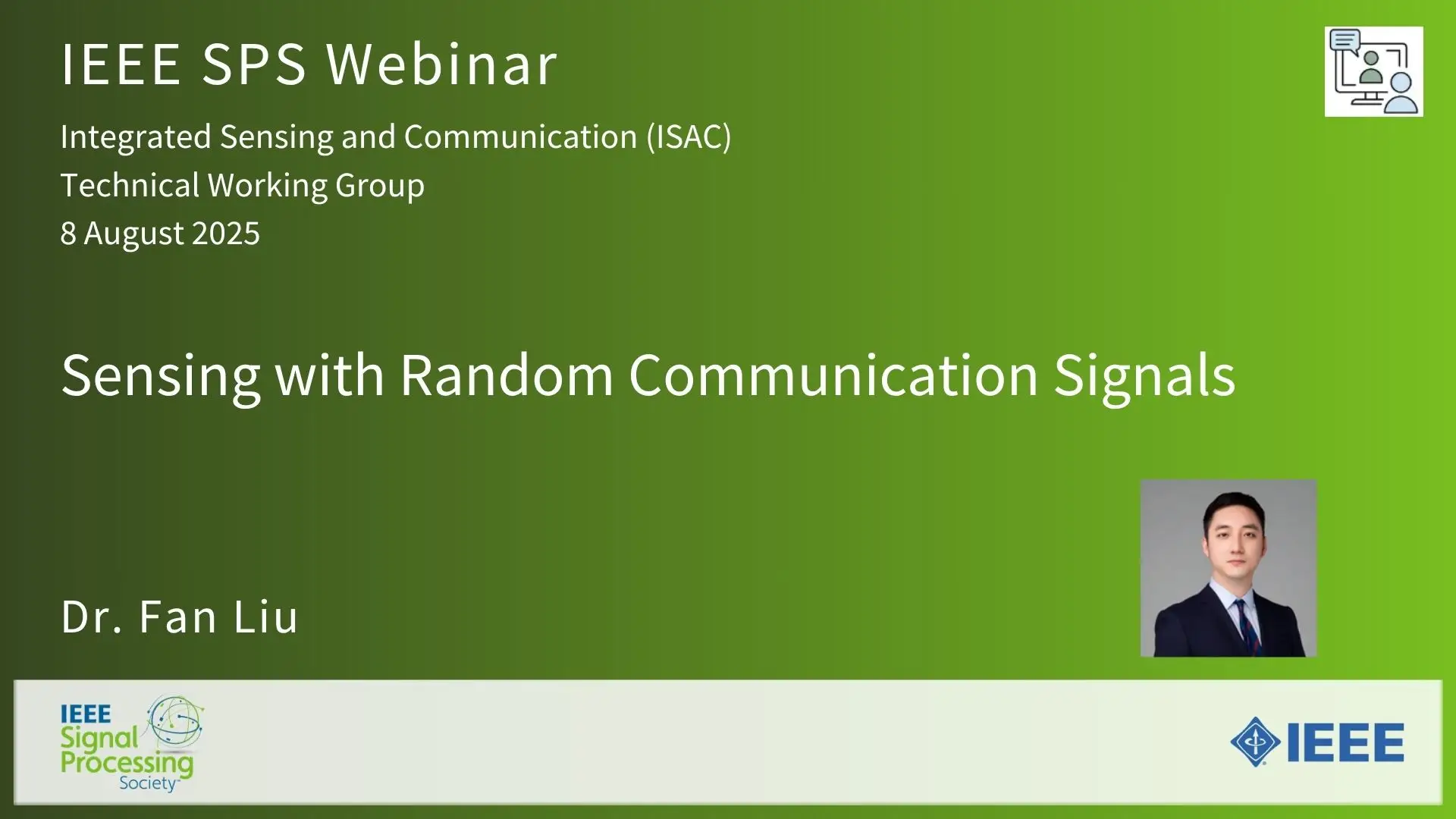
The Integrated Sensing and Communications (ISAC) paradigm is anticipated to be a cornerstone of the upcoming 6G networks. In order to optimize the use of wireless resources, 6G ISAC systems need to harness the communication data payload signals, which are inherently random, for both sensing and communication (S&C) purposes. This talk will provide a comprehensive technical overview of the signal processing methodologies for ISAC transmission with random communication signals. The presenter begins by introducing the deterministic-random tradeoff (DRT) between S&C from an information-theoretic perspective, emphasizing the need for specialized signal processing techniques tailored to random ISAC signals. Building on this foundation, he will review the core signal models and processing pipelines for communication-centric ISAC systems, and analyze the average squared auto-correlation function (ACF) of random ISAC signals, which serves as a fundamental performance metric for multi-target ranging tasks. Drawing insights from these theoretical results, he outlines the design principles for the three key components of communication-centric ISAC systems: modulation schemes, constellation design, and pulse shaping filters. The goal is to either enhance sensing performance without compromising communication efficiency or to establish a scalable tradeoff between the two. Finally, he will conclude by highlighting several open challenges and future research directions in the field of sensing with communication signals.
Duration
1:17:46
Subtitles
✖