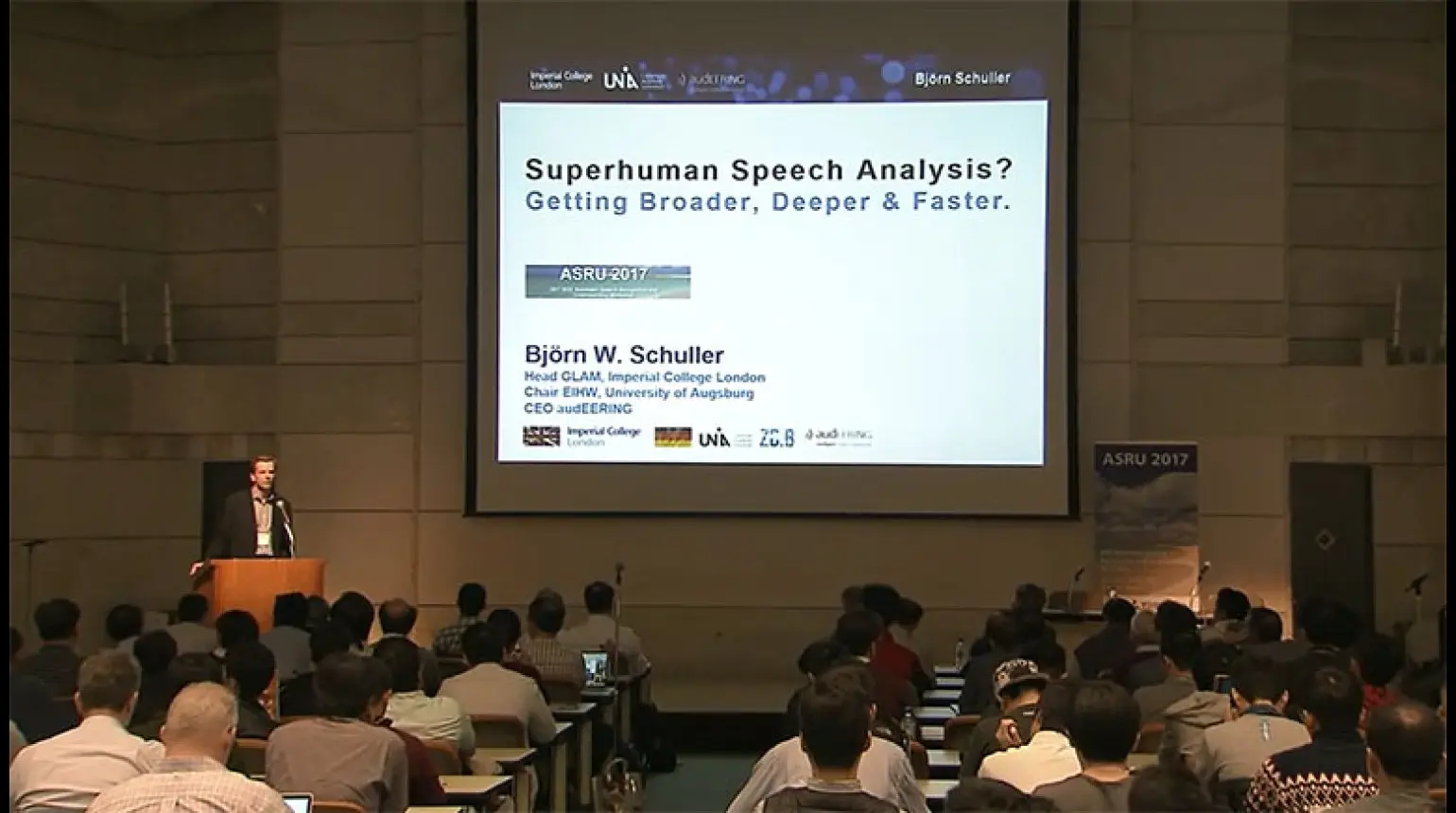
Super-Human Speech Analysis? Getting Broader, Deeper, and Faster
Date
Human performance is often appearing as a glass ceiling when it comes to automatic speech and speaker analysis. In some tasks, such as health monitoring, however, automatic analysis has successfully started to break this ceiling. The field has benefited from more than a decade of deep neural learning approaches such as recurrent LSTM nets and deep RBMs by now; however, recently, a further major boost could be witnessed. This includes the injection of convolutional layers for end-to-end learning, as well as active and autoencoder-based transfer learning and generative adversarial network topologies to better cope with the ever-present bottleneck of severe data scarcity in the field. At the same time, multi-task learning allowed to broaden up on tasks handled in parallel and include the often met uncertainty in the gold standard due to subjective labels such as emotion or perceived personality of speakers. This talk highlights the named and further latest trends such as increasingly deeper nets and the usage of deep image nets for speech analysis on the road to "holistic" superhuman speech analysis "seeing the whole picture" of the person behind a voice. At the same time, increasing efficiency is shown for an ever "bigger" data and increasingly mobile application world that requires fast and resource-aware processing. The exploitation in ASR and SLU is featured throughout.
Duration
1:01:36
Subtitles
✖