MLR-LEAR
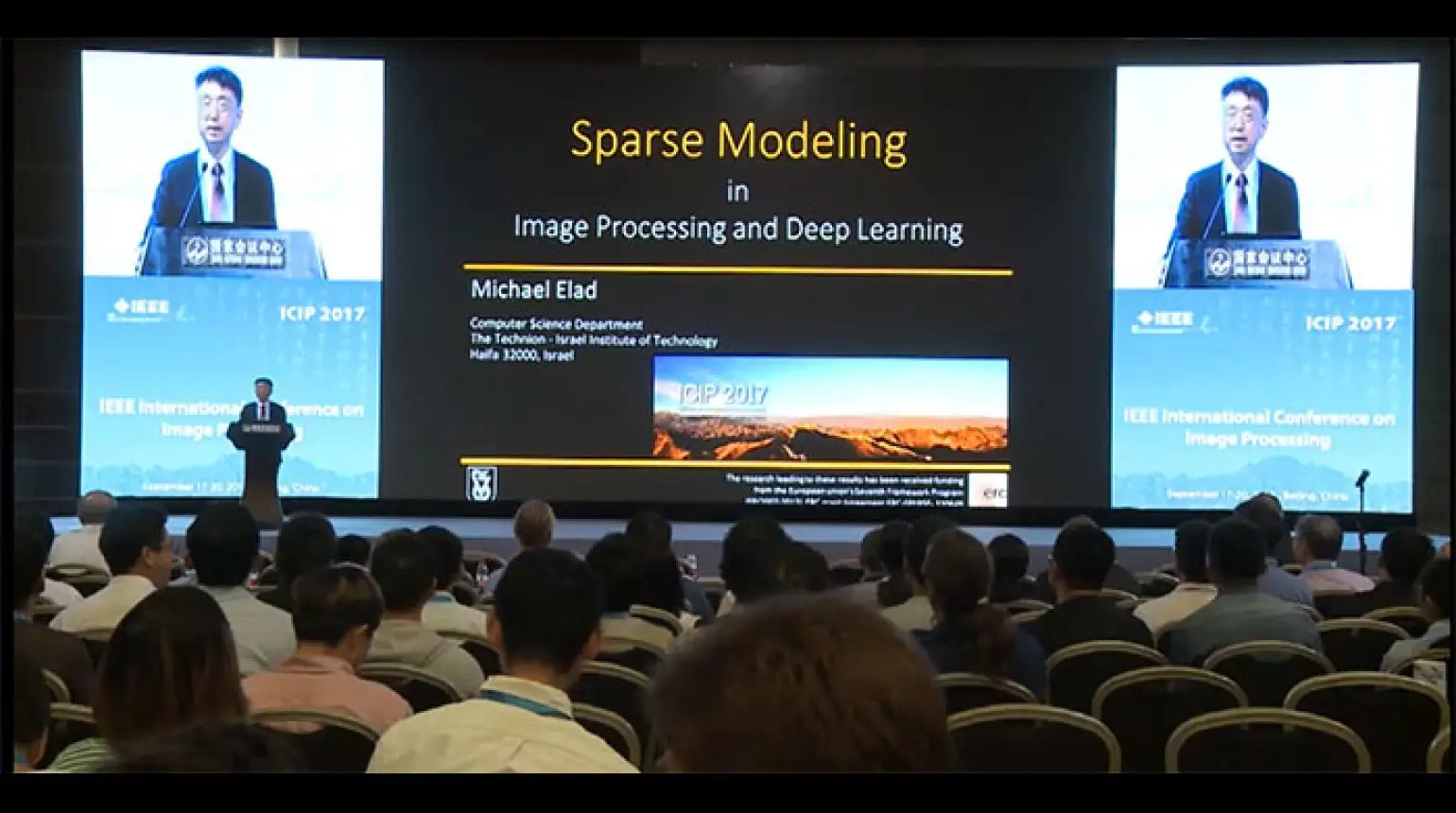
Sparse Modeling in Image Processing and Deep Learning
Date
Sparse approximation is a well-established theory, with a profound impact on the fields of signal and image processing. In this talk, we start by presenting this model and its features, and then turn to describe two special cases of it: 1) the convolutional sparse coding (CSC) and 2) its multi-layered version (ML-CSC). Amazingly, as we will carefully show, ML-CSC provides a solid theoretical foundation to deep-learning. Alongside this main message of bringing a theoretical backbone to deep-learning, another central message that will accompany us throughout the talk. Generative models for describing data sources enable a systematic way to design algorithms, while also providing a complete mechanism for a theoretical analysis of these algorithms' performance. This talk is meant for newcomers to this field and no prior knowledge on sparse approximation is assumed.
Duration
1:04:13
Subtitles
✖
Unsupervised Learning from Max Entropy to Deep Generative Networks

Date
Generative convolutional networks have obtained spectacular results to synthesize complex signals such as images, speech, and music, with barely any mathematical understanding. This lecture will move towards this world by beginning from well, relatively understood maximum entropy modelization. We first show that non-Gaussian and non-Markovian stationary processes requires to separate scales and measure scale interactions, which can be done with a deep neural network. Applications to turbulence models in physics and cosmology will be shown. We shall review deep generative networks such as GAN and variational encoders, which can synthesize realizations of non-stationary processes or highly complex processes such as speech or music. We show that they can be considerably simplified by defining the estimation as an inverse problem. This will build a bridge with maximum entropy estimation. Applications will be shown on images, speech and music generation.
Duration
1:06:52
Subtitles
✖
Self-Supervised Learning: The Future of Signal Understanding

Date
Plenary talk delivered at ICIP 2019 in Taipei.
Duration
1:17:32
Subtitles
✖
Mathematics of Deep Learning

Date
Thanks to the introduction of deep networks for representation learning, the past few years have seen a dramatic increase in the performance of recognition systems. However, the mathematical reasons for this success remain elusive. For example, a key issue is that the neural network training problem is nonconvex, hence, optimization algorithms may not return a global minima. In addition, the regularization properties of algorithms such as dropout remain poorly understood. The first part of this talk will overview recent work on the theory of deep learning that aims to understand 1) how to design the network architecture, 2) how to regularize the network weights, and 3) how to guarantee global optimality. The second part of this talk will present sufficient conditions to guarantee that local minima are globally optimal and that a local descent strategy can reach a global minima from any initialization. Such conditions apply to problems in matrix factorization, tensor factorization, and deep learning. The third part of this talk will present an analysis of the optimization and regularization properties of dropout for matrix factorization in the case of matrix factorization. Examples from neuroscience and computer vision will also be presented.
Duration
0:56:16
Subtitles
✖
Sparce Modeling of Data and Its Relation to Deep Learning

Date
Sparse approximation is a well-established theory, with a profound impact on the fields of signal and image processing. In this talk, we start by presenting this model and its features, and then turn to describe two special cases from it: 1) the convolutional sparse coding (CSC) and 2) its multi-layered version (ML-CSC). Amazingly, as we will carefully show, ML-CSC provides a solid theoretical foundation to deep-learning architectures. Alongside this main message of bringing a theoretical backbone to deep-learning, another central message that will accompany us throughout the talk is this: "Generative models for describing data sources enable a systematic way to design algorithms, while also providing a complete mechanism for a theoretical analysis of these algorithms’ performance." This talk is meant for newcomers to this field and no prior knowledge on sparse approximation is assumed.
Duration
0:54:45
Subtitles
✖
How Classical Machine Learning Can Help Modern Wireless Communications

Date
Data-driven approaches have swept all walks of science and engineering in recent years, with deep neural networks, deep reinforcement learning, and adversarial networks becoming the new staples that everyone uses to tackle a very wide variety of problems. While the empirical success of these methods is truly impressive when a lot of training data are available, there are still many problems that can, in fact, benefit from classical machine learning tools. In this talk, I will focus on showcasing the remarkable potential of latent factor analysis in the context of modern wireless communications. In particular, I will talk about edge-cell interferometry - a technique we recently devised that can reliably decode edge-cell users that are only 3dB above the noise floor, without requiring knowledge of their channels. I will also talk about how latent factor analysis can be used to tackle very hard estimation and optimization problems on the way to 5G and well beyond.
Duration
0:54:02
Subtitles
✖