MLR-DEEP
Modern First-Order Optimization Methods for Imaging Problems (Part 2 of 2)
Date
Optimization is playing an increasingly important role in computational imaging, where many problems reduce to large-scale optimization with structures. The huge number of variables in imaging problems often preclude the use of off-the-shelf, sophisticated algorithms such as the interior-point methods because they exceed memory limits. Scalable optimization algorithms with small memory footprints, low per-iteration costs, and excellent parallelization properties have become the popular choices. Algorithms for structure optimization have recently received significant improvements because the revival of numerical techniques such as operator splitting, stochastic sampling, and coordinate update. Favorable structures in imaging problems can reduce a problem with a huge number of variables and data to simple, small, parallel subproblems. Developing and adapting such algorithms can potentially revolutionize the solution to many imaging problems. However, exploiting structures in large-scale optimization is not an easy task as one needs to recognize those structures to generate simple subproblems, and then combine them into fast and scalable algorithms. This is harder than applying ADMM or block coordinate descent right out of the box. This tutorial focuses on latest first-order algorithms and the techniques of exploiting problem structures. It will provide a high-level overview of operator splitting and coordinate update methods (which include proximal, ADMM, primal-dual, and coordinate descent methods as special cases) in the context of computational imaging, along with concrete examples in image reconstruction, optical flow, segmentation, and others. Emphasis will be given to exploiting problem structures and the fundamental mechanism of building first-order algorithms with fast convergence. Some key results will be "proved" in simplified settings and through graphical illustrations. Stochastic approximating algorithms and recent nonconvex optimization results will also be included.
Duration
1:28:12
Subtitles
✖
Why AI Needs Even More Data Science

Date
Recent advances in AI and deep learning are capturing headlines, and yet suffer from a variety of short-comings, including catastrophic forgetting, inability to generalize robustly, susceptibility to bias, and inadequate techniques for introspection and explanation. Many of these are challenges where an even greater influence from the expertise and rigorous approaches of data science could have profound effects. For example, AI has an urgent and critical need for learning causal models, an area requiring a sound grasp of statistical analysis, principles of identification, and other mainstays of data science. Conversely, differentiable (deep learning) techniques for learning causal structure could bring powerful new tools to data scientists. In another example, information theoretic approaches to understanding information flow in deep neural networks could enable more robust, efficient, and predictable AI. AI for ethical decision making is yet another area with a deep need for complementary data science and AI expertise. This talk will cover these, and other examples of projects we are undertaking in the new MIT-IBM Watson AI Lab, and the necessary interplay of data science and AI. I will also highlight a novel academic+industry approach we are taking to AI research, and why it is both unique and compelling.
Duration
0:53:25
Subtitles
✖
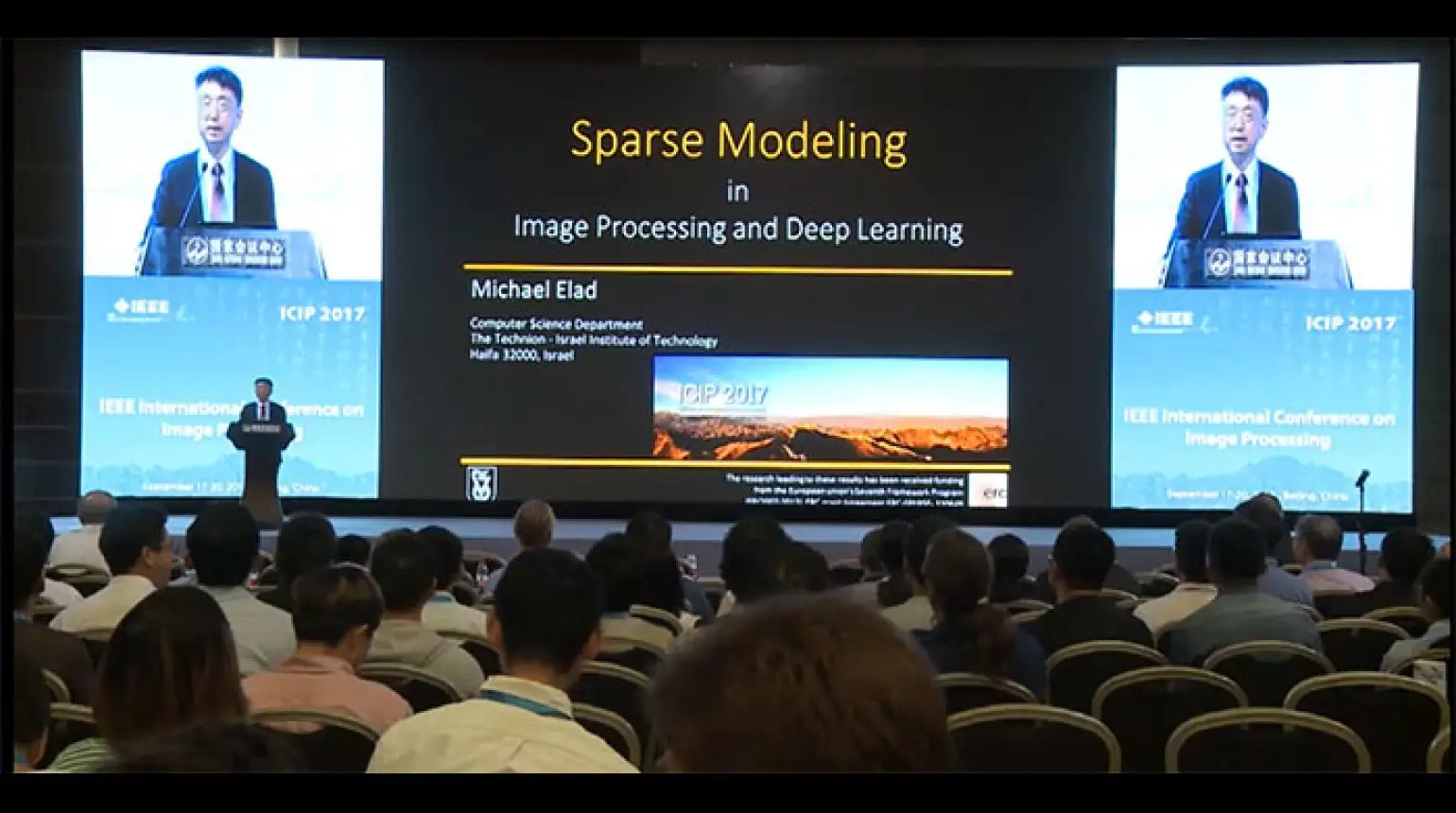
Sparse Modeling in Image Processing and Deep Learning
Date
Sparse approximation is a well-established theory, with a profound impact on the fields of signal and image processing. In this talk, we start by presenting this model and its features, and then turn to describe two special cases of it: 1) the convolutional sparse coding (CSC) and 2) its multi-layered version (ML-CSC). Amazingly, as we will carefully show, ML-CSC provides a solid theoretical foundation to deep-learning. Alongside this main message of bringing a theoretical backbone to deep-learning, another central message that will accompany us throughout the talk. Generative models for describing data sources enable a systematic way to design algorithms, while also providing a complete mechanism for a theoretical analysis of these algorithms' performance. This talk is meant for newcomers to this field and no prior knowledge on sparse approximation is assumed.
Duration
1:04:13
Subtitles
✖
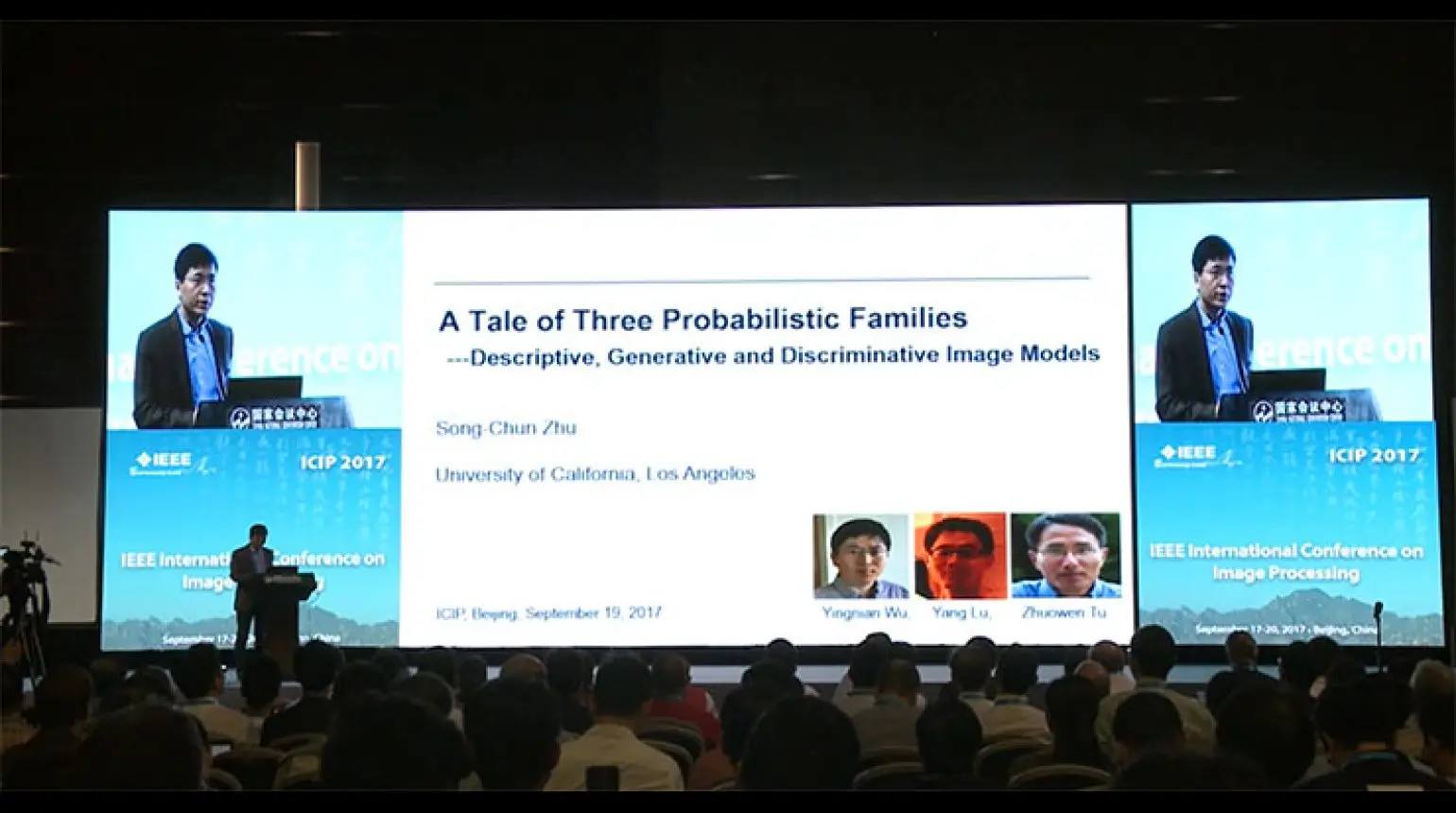
A Tale of Three Families: Descriptive, Generative, and Discriminative Models
Date
Representations of images, in general, belong to three probabilistic families, developed for different regimes of data and tasks. 1) Descriptive models, originated from statistical physics, reproduce certain statistical regularities in data, and are often suitable for patterns in the high entropy regime, such as MRF, Gibbs and FRAME. 2) Generative models, originated from harmonic analysis, seek latent variables and dictionaries to explain data in parsimonious representations, and are often more effective for the low entropy regime, such as sparse models and auto-encoders. 3) Discriminative models are often trained by statistical regression for classification tasks. This talk will start with the Julesz quest on texture and texton representations in the 1960s, and then review the developments, interactions, and integration of these model families in the recent deep learning era, such as the adversary and cooperative models. Then, the talk will draw a unification of these models in a continuous entropy spectrum in terms of information scaling. Finally, the talk will discuss future directions in developing cognitive models for representations beyond deep learning, i.e., modeling the task-oriented cognitive aspects, such as functionality, physics, intents and causality, which are the invisible “dark matter,” by analogy to cosmology, in human intelligence.
Duration
1:06:44
Subtitles
✖
Unsupervised Learning from Max Entropy to Deep Generative Networks

Date
Generative convolutional networks have obtained spectacular results to synthesize complex signals such as images, speech, and music, with barely any mathematical understanding. This lecture will move towards this world by beginning from well, relatively understood maximum entropy modelization. We first show that non-Gaussian and non-Markovian stationary processes requires to separate scales and measure scale interactions, which can be done with a deep neural network. Applications to turbulence models in physics and cosmology will be shown. We shall review deep generative networks such as GAN and variational encoders, which can synthesize realizations of non-stationary processes or highly complex processes such as speech or music. We show that they can be considerably simplified by defining the estimation as an inverse problem. This will build a bridge with maximum entropy estimation. Applications will be shown on images, speech and music generation.
Duration
1:06:52
Subtitles
✖