Meet SPS Member Dr. Abhishek Mahesh Appaji
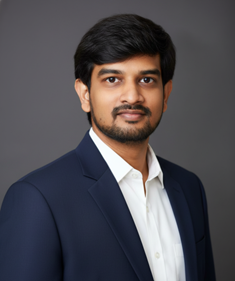
Dr. Abhishek Mahesh Appaji
Associate Professor, B.M.S. College of Engineering & Director, BIG Foundation, Bengaluru
Dr. Abhishek Mahesh Appaji is a distinguished educator, researcher, and administrator based in Bengaluru, India. He currently serves as an Associate Professor at B.M.S. College of Engineering and is the Executive Director of the BIG Foundation, a Section 8 non-profit incubator fostering deep-tech startups. A Senior Member of IEEE, Dr. Appaji was recently honored with the 2026 IEEE Theodore W. Hissey Outstanding Young Professional Award and the 2025 IEEE MGA Achievement Award.
His academic pedigree includes a Ph.D. from Maastricht University (Netherlands), where his work on retinal biomarkers received the Best Thesis Award, and a Postdoctoral Fellowship at The Ohio State University (USA). Dr. Appaji has authored over 100 publications and holds patents in the MedTech space. His leadership within IEEE is extensive, some of the recent roles included the Chair of the IEEE SPS Bangalore Chapter, Execom member of IEEE Bangalore Section, Treasurer of IEEE Bangalore Section among many others. Currently he is serving as Chair of IEEE CS Bangalore Chapter, Treasurer of the IEEE Education Society, member of Steering committee of IEEE DataPort, IEEE MGA/TA Chapter Support Committee and IEEE EAB CPC.
Why Did You Choose to Become Faculty in the Field of Signal Processing?
My journey into faculty life was driven by a fascination with how mathematical abstractions can solve biological mysteries. Signal Processing is the "universal language" of medical diagnostics. Whether it is the rhythmic pulsing of a retinal vessel or the complex firing patterns of neurons, these are all signals waiting to be decoded. I chose an academic career because it offers the unique freedom to pursue high-risk, high-reward research while simultaneously building a laboratory ecosystem. Being a faculty member of Medical Electronics Engineering at B.M.S. College of Engineering allows me to bridge the gap between theoretical signal processing and clinical application, ensuring that the next generation of engineers understands that their code and algorithms have the power to save lives.
How Does Your Work Affect Society?
I believe that technology is only as good as its accessibility and affordability. My work focuses on "frugal innovation"—creating diagnostic tools that can function in resource-constrained environments.
- The Smart Eye Kiosk: This platform uses retinal image processing to screen for psychiatric and neurological disorders. It brings specialized diagnostics to rural areas where mental health professionals are often unavailable.
- Smart Bed Technology: By enhancing non-intrusive sensors that monitor patient vitals without the need for cumbersome wires, we have improved patient comfort and nurse efficiency. This technology is now deployed in over 200 hospitals, proving that signal processing can scale to meet the needs of a nation as vast as India.
- Humanitarian Outreach: Through initiatives like "STEM on Wheels," we use signal processing concepts to teach underprivileged children about sensors and AI, democratizing technical knowledge at the grassroots level. This was sponsored by SPS and also, I was awarded the 2025 IEEE MGA Achievement Award due to my contributions for STEM.
When and Why You Got Involved with SPS?
I joined the Signal Processing Society early in my career because I sought a "technical home" that valued both theoretical rigor and practical impact. I quickly realized that SPS was more than just a publisher of journals; it was a vibrant ecosystem of mentors. More importantly, I got inspired by mentor Prof. K. V. S. Hari, Indian Institute of Science, Bengaluru who was serving as the Chair of IEEE Bangalore Section and later as the IEEE SPS Vice President of Membership. My involvement deepened when I took on the role of Vice Chair and Chair of the IEEE SPS Bangalore Chapter. My goal was to move the chapter beyond simple webinars and toward "hands-on" signal processing. We launched numerous workshops and forums, industry involvements, eventually leading IEEE SPS Bangalore as the Outstanding Chapter Award 2025. I stayed involved because SPS provides the global visibility and resource network (such as the Distinguished Lecturer program) necessary to keep local student branches at the cutting edge of technology.
What Challenges Have You had to Face to Get Where You are Today?
The path from a research lab to a hospital bedside is fraught with challenges. One of the most significant hurdles was navigating the regulatory and commercial landscape of MedTech in India. It is one thing to have a signal processing algorithm with 99% accuracy in a paper; it is an entirely different challenge to ensure that same algorithm works on a low-cost embedded device in a rural clinic with intermittent power. Additionally, balancing the multi-faceted roles of a researcher, a teacher, and an administrator (Executive Director of the BIG Foundation & former R&D Head) requires immense discipline. Transitioning from an "individual contributor" in my Ph.D. and to a "leader of leaders" within the IEEE global structure required a significant shift in mindset and a willingness to learn the "business" & “Style” of engineering.
What was the Most Important Factor in Your Success? Being an SPS volunteer contributed to that?
The most important factor has been my philosophy of "Service-Based Leadership" which matches exactly with IEEE tagline. I strongly believe you are given responsibility to help others rather than stopping others. I found that by focusing on how I could help my students, my chapter, and my professional community, my own career growth followed naturally. SPS volunteerism was the primary catalyst for this. Serving as a Chapter Chair and on global committees gave me a kind of Global Classroom experience. I learned how to manage multi-cultural teams, enjoying late night online meetings to accommodate fellow volunteers, handle large-scale budgets, and negotiate with international stakeholders. These are skills you cannot learn from a textbook. The recognition I received, particularly the 2026 Hissey Award, was directly rooted in the leadership opportunities provided by SPS and MGA. Volunteerism transformed me from a local researcher into a global citizen of the engineering world.
What advice would you give to scientists/engineers in signal processing?
I strongly believe in the following for my fellow upcoming scientists/engineers and YPs:
- Don't get lost in the beauty of math alone or don't build the technology because you know how to. Technology truly works when used correctly by the end users.
- The most exciting developments in any field are happening at the intersections—my own example is Signal Processing meets Neuroscience. Don't be afraid to step out of your comfort zone.
- Most importantly don't wait until you are a "Senior Member" to volunteer. Start a student branch, mentor a junior, or organize a small hackathon or just an easy to go webinar. The network you build through IEEE and SPS will be your greatest asset when you face the inevitable challenges of professional life and it's a lifelong asset which I have got till date.
- If you have a great idea, learn about patents, regulatory standards, and entrepreneurship. The world doesn't just need more papers; it needs more solutions that actually reach the community.