Meet ICASSP 2026 Organizers Ana Isabel Pérez-Neira and Xavier Mestre

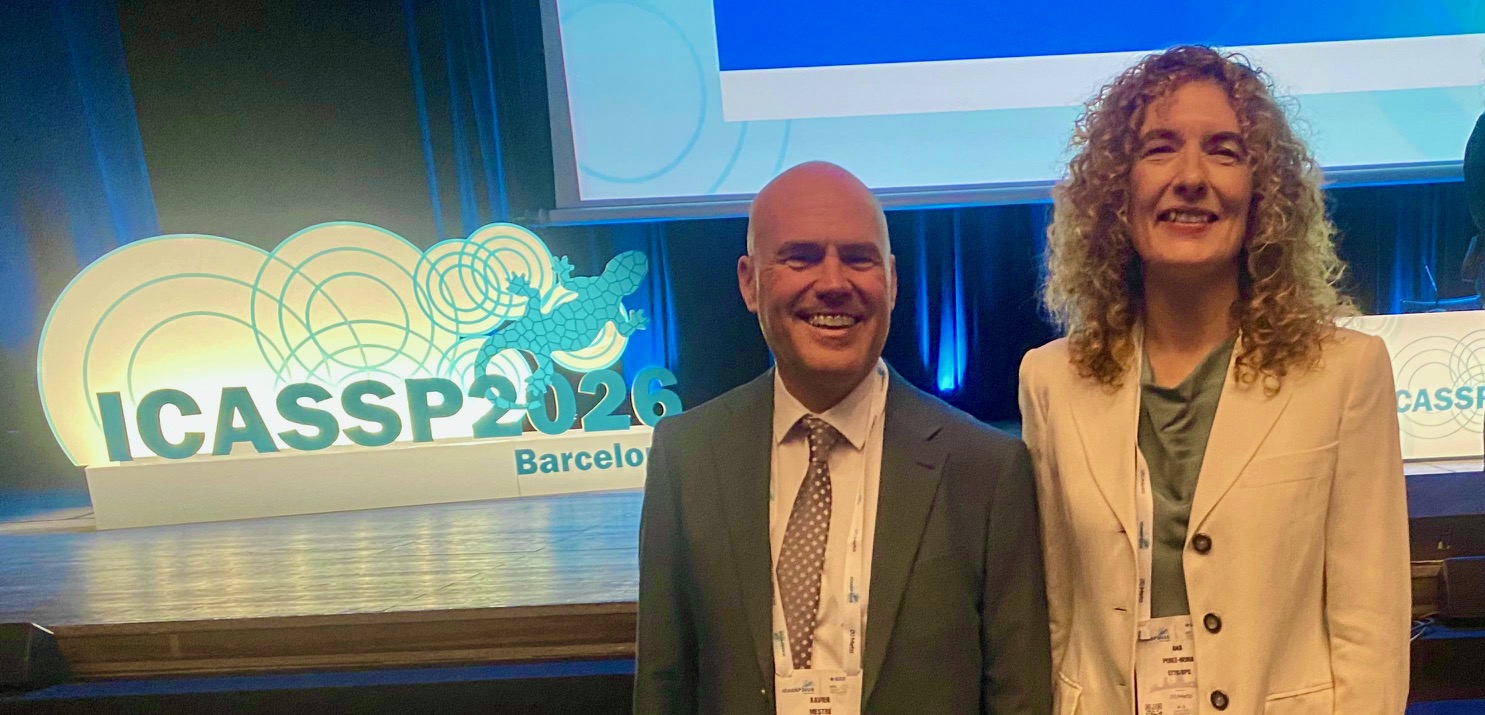
by Charles Casimiro Cavalcante
We spoke with SPS members and ICASSP organizers Ana Isabel Pérez-Neira and Xavier Mestre about how they successfully put on a conference that had the highest number of submissions in ICASSP history.
What was the main motivation for organizing the ICASSP in Barcelona?
The main reason is visibility, Barcelona offers an exceptional combination of scientific excellence, international connectivity, cultural richness, and world-class conference infrastructure, making it an ideal venue for ICASSP.
What were the biggest obstacles faced during the organization, and how did you overcome them? And how the pandemic affected the plans?
ICASSP continues to grow in both size and complexity, making its organization an increasingly demanding professional undertaking. Successfully managing the conference now requires extensive experience, long-term planning, and a substantial commitment of time and resources. The coordination effort spans multiple dimensions, including the technical program, sponsorship and industry engagement, venue logistics, financial management, publication processes, digital infrastructure, and the overall attendee experience. In addition, the large number of submissions, parallel sessions, workshops, tutorials, and satellite events require highly efficient organizational structures and close collaboration among many committees and volunteers. As the conference evolves and expands globally, ensuring consistent quality and a smooth experience for thousands of participants has become a year-round responsibility that demands both professional expertise and sustained dedication.
Initially, ICASSP in Barcelona was scheduled to take place in May 2020. However, the COVID-19 pandemic completely reshaped our plans. Following the worldwide lockdown declared in March 2020, we made the decision to transform the conference into a fully virtual event. Despite the unprecedented challenges, the conference was successfully delivered and became the first IEEE flagship conference to be organized entirely online (see “A Green ICASSP 2020 in Virtual Barcelona,” SP Magazine, September 2020).
Right after the conclusion of the virtual ICASSP 2020, Prof. Ahmed H. Tewfik offered us the opportunity to organize ICASSP once again in Barcelona, this time as a fully in-person event in 2026. At that moment, we were still deeply disappointed by the unavoidable cancellation of the physical 2020 conference experience due to the pandemic, so we accepted the proposal almost instinctively, without fully realizing the magnitude of what organizing ICASSP six years later would entail. What we could not foresee at the time was the extraordinary growth that the conference would experience in the following years. By 2026, the expected attendance had more than doubled compared to the original plans for 2020, and the scope of the conference had expanded dramatically, with many new parallel activities, industrial initiatives, networking events, educational programs, and satellite meetings needing to be accommodated. This rapid evolution transformed the organization of ICASSP into an even more complex and ambitious endeavor, requiring a much larger operational structure, expanded coordination efforts, and an exceptional level of commitment from all members of the organizing committee.
How did you define the central themes of the event, and how did you balance well-established topics with emerging trends in the field, e.g. the increasing number of artificial intelligence topics?
The central theme of ICASSP 2026 was “Where signals meet intelligence,” with the objective of preserving the conference’s strong foundations in signal processing while also embracing the rapid evolution of the field and the transformative impact of artificial intelligence. ICASSP has always been a broad and multidisciplinary conference, and we wanted the technical program to reflect both continuity and innovation.
On one hand, we maintained strong support for the traditional core areas that have historically defined ICASSP, including speech and language processing, audio and acoustics, image and video processing, statistical signal processing, sensor arrays, communications, and biomedical applications. These domains continue to be scientifically vibrant and remain essential pillars of the signal processing community.
At the same time, it was impossible to ignore the tremendous growth of AI, and machine-learning-driven research across virtually all tracks of the conference. In fact, the statistics from ICASSP26 clearly illustrate this evolution. Machine Learning represented the largest share of submissions, accounting for approximately 24% of all papers, followed by Speech and Language Processing with 16% and Image and Video Processing with 14%. This confirms that AI-related methodologies are now deeply embedded across the signal processing landscape rather than existing as a separate research niche.
Our goal, however, was not simply to follow trends, but to ensure that emerging AI topics were integrated in a way that remained aligned with the scientific identity of ICASSP. We therefore encouraged contributions that combined modern AI approaches with core signal processing principles, emphasizing aspects such as robustness, efficiency, interpretability, multimodal learning, and real-world deployment. The conference also aimed to maintain a healthy balance between data-driven approaches and methodological innovation rooted in signal processing theory.
Another important aspect was ensuring diversity in the overall program. ICASSP26 featured not only a very strong technical program, but also an expanded industry program (80% of the whole program), educational activities, entrepreneurship initiatives, and programs for students and young professionals. The conference included industry keynotes, expert talks, show-and-tell demonstrations, panels, tutorials, workshops, and entrepreneurship forums, reflecting the increasingly interdisciplinary and application-driven nature of the field.
More broadly, the scale of participation itself demonstrated how the field is evolving. ICASSP26 received nearly 11,200 regular paper submissions and accepted close to 4,800 papers overall, making it one of the largest editions in the history of the conference. Managing this growth while preserving scientific quality and thematic balance was one of the major objectives of the organizing committee.
Overall, our philosophy was to ensure that ICASSP26 remained faithful to its signal processing roots while serving as a forward-looking forum where emerging AI-driven directions, industrial innovation, and interdisciplinary applications could naturally coexist and reinforce one another. We are well-aware of the difficulties in keeping this equilibrium.
You had the highest number of submissions in ICASSP history. Was that a “curse of dimensionality”? How the peer-review process managed such challenge?
Yes, without a doubt, handling the unprecedented number of submissions was one of the greatest technical and organizational challenges we faced for this edition of ICASSP. At one stage of the submission process, we were approaching nearly 12,000 submitted papers. After removing duplicate and invalid entries, the final number was slightly lower, but it still represented an extraordinary increase of approximately 58% compared to ICASSP 2025. Most of the submissions took place hours before the deadline, a which point we realized that this growth was far beyond what the traditional reviewer pool for ICASSP could reasonably absorb.
At that point, it became clear that the standard review infrastructure would not be sufficient, and we immediately raised the issue with the Technical Program Committee chairs. Together, we launched a coordinated effort to significantly expand the reviewer base across all areas. The response from the community leadership was remarkable. The TPC chairs, in particular, demonstrated exceptional professionalism, diligence, and responsiveness throughout the entire process, and their contribution was absolutely instrumental in making the review process feasible.
One of the first measures we implemented was to revisit the author database from ICASSP 2025. During the previous submission cycle, authors had been asked whether they would be willing to serve as reviewers for the following edition of the conference. We leveraged this information extensively. The list of volunteers was shared with the TC chairs, and whenever possible, we also provided links to scholar webpages and publication profiles to facilitate the evaluation of expertise and suitability. Thanks to this collective effort, the TC chairs ultimately succeeded in recruiting an impressive total of 6,207 reviewers.
As the submissions were examined more closely, it also became apparent that a fraction of the papers was clearly below the expected quality threshold. Under different circumstances, a desk-rejection policy could have been extremely valuable in reducing the reviewing burden and allowing reviewers to focus their efforts on stronger submissions. However, since such a policy had not been explicitly announced on the conference website beforehand, SPS guidelines did not allow us to introduce it retroactively during the process.
Despite the scale of the challenge, the peer-review process ultimately proved remarkably robust. In total, 32,987 reviews were collected, corresponding to an average of 2.96 reviews per paper. Around 80% of the submissions received at least three reviews. For the smaller subset of papers that received only two reviews, we carefully verified that the evaluations were sufficiently consistent and concurrent to support a fair decision process.
Areas that should be addressed in future editions include the possibility of implementing an initial pre-screening phase in which papers falling outside the scope of the conference can be immediately rejected, thereby helping to save reviewing resources. Another important aspect is the development of tools capable of identifying both AI-generated papers and AI-generated reviews. In the case of ICASSP 2026, the rebuttal phase proved useful in identifying the latter.
Looking back, this experience truly highlighted both the scale and the vitality of our research community. Most importantly, it showcased the extraordinary dedication of all those involved in the review process. We would like to express our deepest and most heartfelt gratitude to the TPC chairs, track chairs, and area chairs for their tireless work, commitment, and sense of responsibility throughout this demanding process. Their leadership and countless hours of effort were essential to maintaining the quality, fairness, and integrity of ICASSP under truly historic circumstances.
What were the greatest difficulties in coordinating the organizing team, especially among members from different institutions or countries?
Initially, organizing ICASSP26 felt like assembling a massive puzzle made up of thousands of interconnected pieces that ultimately had to come together into a coherent, attractive, and high-quality conference program. Achieving this required an enormous coordination effort involving more than 20 chairs in the Organizing Committee, each responsible for a different area, together with 12 primary Technical Chairs and the collaboration of several external partners and service providers. In many respects, ICASSP26 became a true large-scale coordination challenge.
We were able to successfully manage this complexity thanks to the experience gained from organizing ICASSP2020 and other previous conferences, as well as the remarkable dedication and expertise of all the volunteers involved in the Organizing Committee. Their contribution was truly outstanding.
Organizing ICASSP must be understood as managing a major international project composed of many interdependent work packages that evolve simultaneously over two years. Technical program preparation, industry activities, sponsorship, finances, venue logistics, publications, tutorials, workshops, student activities, communications, and attendee experience all progress in parallel and continuously interact with one another. The real challenge lies in synchronizing all these moving parts so that, at the end, they converge seamlessly into a successful and memorable conference experience.
If you were to organize this event again, what would you do differently, and what recommendations would you give to researchers who intend to take on the organization of large-scale events?
If we were to organize ICASSP again, one of the main things we would do differently would be to approach the conference even more explicitly as a large-scale professional project from the very beginning. One of the key lessons we learned is that the complexity of ICASSP has grown enormously over the years. Today, organizing such a conference is no longer something that can rely solely on goodwill and volunteer enthusiasm; it requires strong project-management structures, clear workflows, early planning, and continuous coordination among many stakeholders.
In hindsight, we would place even greater emphasis on defining, at a very early stage, a detailed project structure with clearly identified work packages, responsibilities, timelines, dependencies, and decision-making processes. This became particularly important because many activities — technical program management, industry relations, sponsorship, educational initiatives, student and young professional activities, logistics, publicity, finance, and sustainability, evolve in parallel and are highly interconnected.
We also learned the importance of integrating all parts of the conference more tightly. In modern ICASSP editions, the technical program is only one dimension of a much broader ecosystem that includes industry programs, entrepreneurship initiatives, educational outreach, legacy activities, and networking events. Better synchronization between these components from the beginning would make the overall experience even stronger. The experience also showed us the importance of maintaining close communication with IEEE SPS staff, external contractors, and professional conference organizers, especially when unexpected situations arise.
Another important lesson concerns sustainability and scalability. Conferences of this size involve thousands of participants, massive logistics, and significant operational complexity. Sustainability objectives, attendee experience, and financial risk management should therefore be embedded into the conference design from the outset, rather than treated as secondary considerations.
For researchers considering organizing large-scale conferences, our first recommendation would be to build a strong and trustworthy team. The success of an event like ICASSP depends fundamentally on the people behind it. Delegation, communication, and mutual trust are essential, because no individual can oversee all aspects of such a conference alone.
Second, it is important to understand that organizing a major conference requires a clear project breakdown with its corresponding timeline and a substantial long-term commitment. During the final months before the event, the workload can easily become equivalent to a full-time professional responsibility. Experience from previous conferences is extremely valuable, but flexibility and the ability to react to unforeseen situations are equally important.
Finally, our advice would be not to lose sight of the ultimate objective: creating a meaningful scientific and human experience for the community. Beyond papers and presentations, conferences are about building connections, inspiring new ideas, supporting younger generations, and strengthening the research ecosystem. When all these elements come together successfully, the effort becomes enormously rewarding.
Which aspects of the organization produced the greatest unexpected benefits, for participants, for the institutions involved, or for the scientific community?
One of the most positive and somewhat unexpected outcomes of organizing ICASSP26 was the extent to which the conference evolved beyond a traditional technical event and became a truly multidimensional meeting point for the broader signal processing community. While the scientific program remained the core of the conference, several complementary initiatives generated an impact that exceeded our initial expectations.
A particularly rewarding aspect was the very strong participation of students and young professionals. The dedicated program, which included networking activities, mentoring initiatives, career-development sessions, and social events, created a highly dynamic and inclusive atmosphere throughout the conference. The level of engagement clearly demonstrated that younger generations are looking not only for technical excellence, but also for opportunities to build community, develop professionally, and connect across disciplines.
Another major benefit came from the expansion of the industry program. The integration of industry keynotes, expert talks, panels, entrepreneurship activities, and show-and-tell demonstrations created a much stronger interaction between academia and industry than in many previous editions. This helped participants better understand emerging technological needs and real-world applications, while companies gained direct access to a highly specialized and international talent pool. The conference therefore became not only a scientific forum, but also a platform for innovation, collaboration, and technology transfer.
We were also pleasantly surprised by the positive reception of some of the newer initiatives, particularly the Legacy Program and the educational outreach activities. The Legacy Program introduced discussions around sustainability, social awareness, and the broader societal role of signal processing, opening conversations that are becoming increasingly important for the research community. Similarly, the activities involving schools and younger students helped demonstrate how signal processing underpins many modern technologies, creating outreach opportunities beyond the traditional academic audience.
From an institutional perspective, the conference significantly strengthened collaboration among universities, research centers, industry partners, IEEE SPS, and local organizations. Large-scale events like ICASSP naturally create long-lasting professional networks and collaborative relationships that often continue well beyond the conference itself.
Finally, one of the most meaningful outcomes was seeing the global diversity and scale of participation. ICASSP26 brought together thousands of participants from many countries, research backgrounds, and career stages, reinforcing the role of ICASSP as one of the major international meeting points for the signal processing community. The conference demonstrated how rapidly the field is evolving and how important it is to maintain spaces where established areas, emerging AI-driven research, industrial innovation, and interdisciplinary collaboration can coexist and enrich one another.
Learn more about Ana and Xavier:
Ana Pérez-Neira is full professor at Universitat Politècnica de Catalunya in the Signal Theory and Communication department. Currently, she is the Director of Centre Tecnològic de Telecomunicacions de Catalunya, Spain. Her research is in signal processing for communications, focused on satellite communications. She has been the leader of over 35 projects and has participated in over 50. She is the author of over 80 journal papers and more than 400 conference papers. She is co-author of 7 books and 13 chapters, and 8 patents, all contributing to the advancement of signal processing and communications. Click here to learn more.
Xavier Mestre received his MSc and PhD degrees in Electrical Engineering from the Technical University of Catalonia (UPC) in 1997 and 2002, respectively, and a five-year degree in Mathematics in 2011. During his PhD studies, he was awarded a scholarship (1998–2001) from the Catalan Government. From January 1998 to December 2002, he was with UPC’s Communications Signal Processing Group, where he worked as a Research Assistant (1998–2000) and Research Associate (2001–2002). In January 2003, he joined CTTC, where he currently holds the position of Research Director. He has served as Head of the Radiocommunications Area (2003–2012) and of the Advanced Signal and Information Theory Department (2012–2021). Since 2022, he has been Scientific Coordinator and a member of the CTTC Direction Unit. Click here to learn more.